MCQ
Propene on hydroboration and oxidation produces
- ✓$CH_3CH_2CH_2OH$
- B$CH_3CHOHCH_3$
- C$CH_3CHOHCH_2OH$
- D$CH_3CH_2CHO$
$3C{H_3} - CH = C{H_2} + B{H_3}\,\xrightarrow{{{\text{(Hydroboration)}}}}$ ${(C{H_3}C{H_2}C{H_2})_3}B$ $\xrightarrow[{{\text{(Oxidation)}}}]{{{H_2}{O_2}/O{H^ - }}}$ ${\text{3 C}}{{\text{H}}_3}{\text{C}}{{\text{H}}_2}{\text{C}}{{\text{H}}_2}{\text{OH}}$
Generate a complete, print-ready paper with questions like this in minutes — across 16+ boards, with answer keys.
Cyclohexane $\xrightarrow{{hv/C{l_2}}}(X)\xrightarrow{{alc.KOH/\Delta }}(Y)\mathop {\xrightarrow{{(i)\,{O_3}}}}\limits_{(ii)\,{H_2}O/Zn} (Z)$
$(Z)$ will be :
The curves $M$ and $N$ represent the variation of energy with reaction coordinate for the reaction in absence and presence of catalyst
Which value represents the activation energy $(E_a)$ for the backward reaction in the presence of catalyst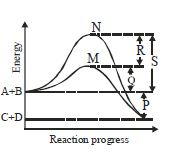
$(i)$ $X + Y \rightleftharpoons M$ very rapid equilibrium
$(ii)$ $M + Z \to P$ slow
$(iii)$ $O + Y \to N$ very fast
What is the rate law for this reaction
$R - X\xrightarrow{{KCN}}A\mathop {\xrightarrow{{NaOH}}}\limits_{{H_2}O} $ $B$ is
Reason : Hydrated $BaO_2$ is not available.