Question
Prove by factor theorem that
$(2x - 1)$ is a factor of $6x^3 - x^2 - 5x +2$

Answer

$(2 x-1)$ is a factor of $6 x^3-x^2-5 x+2$
$2 x-1=0 \Rightarrow x=\frac{1}{2}$
Substituting this value, we get
$f \left(\frac{1}{2}\right)=6 \times \frac{1}{2} \times \frac{1}{2} \times \frac{1}{2}-\frac{1}{2} \times \frac{1}{2}-5 \times \frac{1}{2}+2$
$=\frac{3}{4}-\frac{1}{4}-\frac{5}{2}+2$
$=\frac{1}{2}-\frac{5}{2}+2=-2+2=0$
Hence $(2 x-1)$ is a factor of $6 x^3-x^2-5 x+2$

Need a full question paper?

Generate a complete, print-ready paper with questions like this in minutes — across 16+ boards, with answer keys.
Start Generating Free

Similar questions

Find the value of $k$, if $(x-2)$ is a factor of $x^3+2 x^2-k x+10$. Hence, determine whether $(x+5)$ is also a factor.
If (4a + 5b) (4c – 5d) = (4a – 5d) (4c + 5d), prove that a, b, c, d are in proporton.
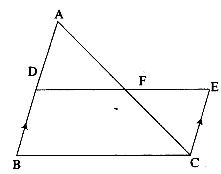
In the given figure $ABC$ and $CEF$ are two triangles where $BA$ is parallel to $CE$ and $AF: AC = 5: 8.$

(i) Prove that $\triangle ADF \sim \triangle CEF$
(ii) Find $AD$ if $CE = 6 cm$
(iii) If $DF$ is parallel to $BC$ find area of $\triangle ADF:$ area of $\triangle ABC.$
Hundred identical cards are numbered from 1 to 100. The cards The cards are well shuffled and then a card is drawn. Find the probability that the number on card drawn is:  a multiple of 5 
Prove that the angle bisectors of the angles formed by producing opposite sides of a cyclic quadrilateral (Provided they are not parallel) intersect at the right angle.
A certain number of metallic cones, each of radius $2\ cm$ and height $3\ cm,$ are melted and recast into a solid sphere of radius $6\  cm.$ Find the number of cones used.
Given:
A = {x: 11x – 5 > 7x + 3, x ∈ R} and
B = {x: 18x – 9 ≥ 15 + 12x, x ∈ R}.
Find the range of set A ∩ B and represent it on the number line.
Point A and B have Co-ordinates (7, −3) and (1, 9) respectively. Find:
(i) the slope of AB
(ii) the equation of perpendicular bisector of the line segment AB.
(iii) the value of ‘p’ of (-2, p) lies on it.
Use factor theorem to factorise the following polynomials completely: $4x^3 + 4x^2 – 9x – 9$
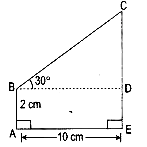
In figures, find the length CF.