Question
Prove by vector method that $\sin (\alpha+\beta)=\sin \alpha \cdot \cos \beta+\cos \alpha \cdot \sin \beta$.
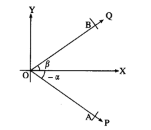
Let $\angle X O P$ and $\angle X O Q$ be in standard position and $m \angle X O P=-\alpha, m \angle X O Q=\beta$.
Take a point A on ray OP and a point B on ray OQ such that OA = OB = 1. Since cos (-α) = cos α and sin (-α) = -sin α,
$\mathrm{A}$ is $(\cos (-\alpha), \sin (-\alpha))$
i.e. $\left(\cos \alpha_1-\sin \alpha\right)$
$B$ is $\left(\cos \beta_1 \sin \beta\right)$
$\therefore \overline{\mathrm{OA}}=(\cos \alpha) \bar{i}-(\sin \alpha) \cdot \bar{j}+0 \cdot \bar{k}$
$\overline{\mathrm{OB}}=(\cos \beta) \cdot \bar{i}+(\sin \beta) \cdot \bar{j}+0 \cdot \bar{k}$
$\therefore \overline{\mathrm{OA}} \times \overline{\mathrm{OB}}=\left|\begin{array}{ccc}\hat{i} & \hat{j} & \hat{k} \\ \cos \alpha & -\sin \alpha & 0 \\ \cos \beta & \sin \beta & 0\end{array}\right|$
$=(\cos \alpha \sin \beta+\sin \alpha \cos \beta) \bar{k}$
... (1)
The angle between $\overline{\mathrm{OA}}$ and $\overline{\mathrm{OB}}$ is $\alpha+\beta$.
Also $\overline{\mathrm{OA}}, \overline{\mathrm{OB}}$ lie in the $\mathrm{XY}$-plane.
$\therefore$ the unit vector perpendicular to $\mathrm{OA}$ and $\mathrm{OB}$ is $\bar{k}$.
$\therefore \overline{\mathrm{OA}} \times \overline{\mathrm{OB}}=[\mathrm{OA} \cdot \mathrm{OB} \sin (\alpha+\beta)] \bar{k}$
$=\sin (\alpha+\beta) \cdot \bar{k}_{\ldots(2)}$
∴ from (1) and (2), sin (α + β) = sin α cos β + cos α sin β.
Generate a complete, print-ready paper with questions like this in minutes — across 16+ boards, with answer keys.
$f(x)=x^2-3 x-1, x \in\left[\frac{-11}{7}, \frac{13}{7}\right]$
$x = t ^2+ t +1, y =\sin \left(\frac{\pi t}{2}\right)+\cos \left(\frac{\pi t}{2}\right)$ at $t =1$