Question
Prove that: $\frac{2^\text{n}+2^{\text{n-1}}}{2^{\text{n}+1}-2^\text{n}}=\frac{3}{2}$

Answer

We have, $\frac{2^\text{n}+2^{\text{n-1}}}{2^{\text{n}+1}-2^\text{n}}=\frac{2^\text{n}​+2​^\text{n}\times2^{-1}​}{2^\text{n}\times\text{2}^1-2^\text{n}}$
$=\frac{2^\text{n}[1+2^{-1}]}{2^\text{n}[2-1]}$
$=\frac{1+\frac{1}{2}}{1}$
$=1+\frac{1}{2}$
$=\frac{3}{2}$
$\Rightarrow\frac{2^\text{n}+2^{\text{n}-1}}{2^{\text{n}+1}-2^\text{n}}=\frac{3}{2}$

Need a full question paper?

Generate a complete, print-ready paper with questions like this in minutes — across 16+ boards, with answer keys.
Start Generating Free

Similar questions

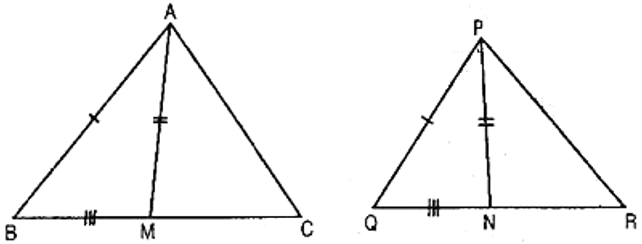
Two sides $AB$ and $BC$ and median $AM$ of the $\triangle ABC$ are respectively equal to side $PQ$ and $QR$ and median $PN $of $\text{PQR} ($See figure$)$. Show that:
$i. \triangle ABM \cong \triangle PQN$
$ii. \triangle ABC \cong \triangle PQR$
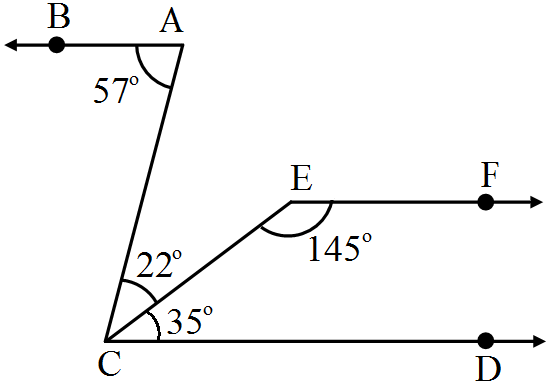
In figure, show that $AB\ ||\ EF$.
Prove that: $\Big(\frac{64}{125}\Big)^{-\frac{2}{3}}+\frac{1}{\Big(\frac{256}{625}\Big)^\frac{1}{4}}+\Big(\frac{\sqrt{25}}{\sqrt[3]{64}}\Big)^0=\frac{61}{16}$
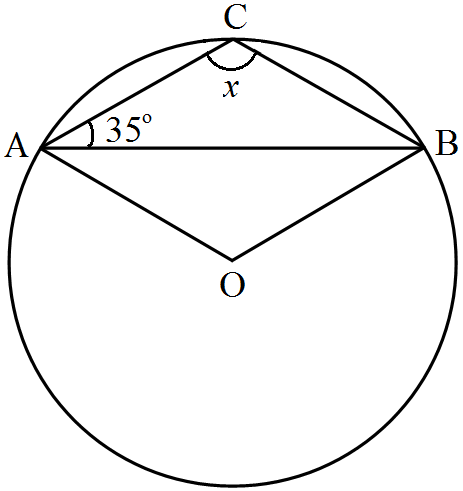
If $O$ is the centre of the circle, find the value of $x$ in the following figure:
Draw a histogram for the daily earning of 30 drug stores in the following table:
Daily earning (in ₹): $450-500$ $500-550$ $550-600$ $600-650$ $650-700$
Number of stores: $16$ $10$ $7$ $3$ $1$
If $x = 3$ and $y = -1$, find the values of the following using in identity: $\Big(\frac{5}{\text{x}}+5\text{x}\Big)\Big(\frac{25}{\text{x}^2}-25+25\text{x}^2\Big)$
Express the following decimals in the form $\frac{\text{p}}{\text{q}},$ where $p, q$ are integers and $\text{q}\neq0.$ $0.3\overline{178}$
In $\triangle\text{ABC},\angle\text{A}=50^{\circ}$ and $\angle\text{B}=60^{\circ}$ Determine the longest and shortest sides of the triangle.
Find the cost of laying grass in a triangular field of sides $50 m, 65 m$ and $65 m$ at the rate of $Rs.7$ per $m ^2$.
A point lies on the $x-$axis at a distance of $7$ units from the $y-$axis. What are its coordinates? What will be the coordinates if it lies on $y-$axis at a distance of $-7$ units from $x-$axis?