Question
Prove that 3 + √5 is an irrational number.

Answer

Let us assume that 3 + √5 is a rational number.
So, we can find co-prime integers ‘a’ and ‘b’ (b ≠ 0) such that
$
\begin{aligned}
& 3+\sqrt{5}=\frac{a}{b} \\
\therefore \quad & \sqrt{5}=\frac{a}{b}-3
\end{aligned}
$
Since, $a$ and $b$ are integers, $\frac{a}{b}-3$ is a rational
number and so √5 is a rational number.
But this contradicts the fact that √5 is an irrational number.
∴ Our assumption that 3 – √5 is a rational number is wrong.
3 + √5 is an irrational number.

Need a full question paper?

Generate a complete, print-ready paper with questions like this in minutes — across 16+ boards, with answer keys.
Start Generating Free

Similar questions

Draw a circle with center at point O and radius 5cm. Draw its chord AB, draw the perpendicular bisector of line segment AB. Does it pass through the center of the circle?
Each side of a rhombus is 10cm long and one of its diagonals measures 16cm. Find the length of the other diagonal and hence find the area of the rhombus.
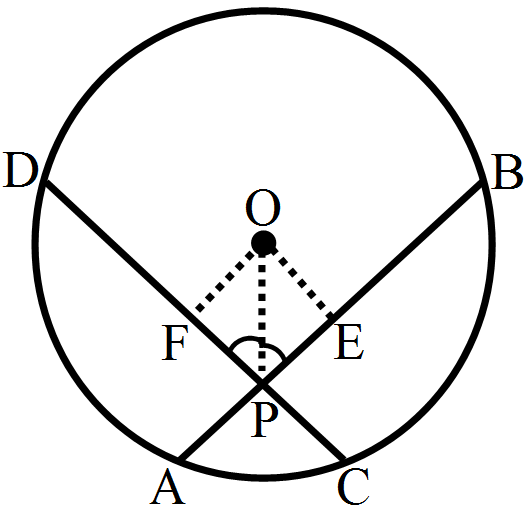
In the given figure, O is the centre of a circle in which chords AB and CD intersect at P such that PO bisects $\angle\text{BPD}.$ Prove that AB = CD.
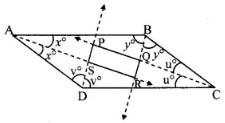
Prove that quadrilateral formed by the intersection of angle bisectors of all angles of a parallelogram is a rectangle.

Image
Given: □ABCD is a parallelogram.
Rays AS, BQ, CQ and DS bisect ∠A, ∠B, ∠C and ∠D respectively.
To prove: □PQRS is a rectangle.
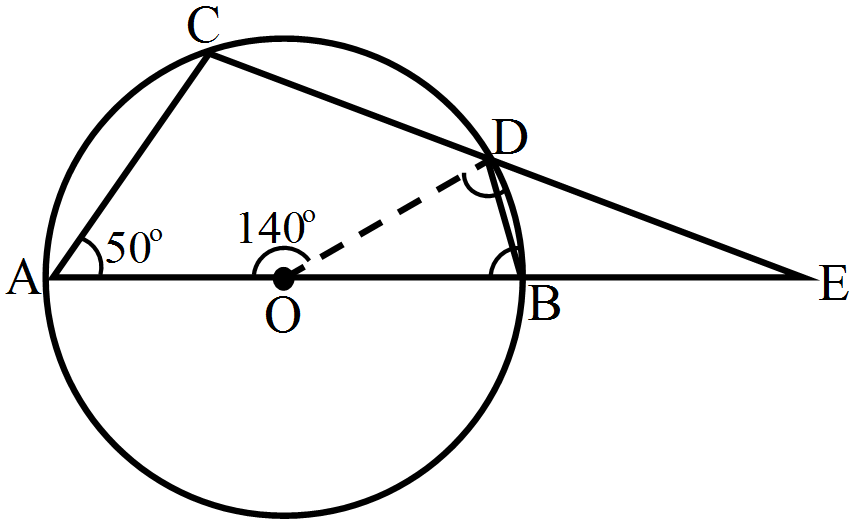
In the given figure, O is the centre of a circle. If $\angle\text{AOC}=140^\circ$ and $\angle\text{CAB}=50^\circ,$ calculate
  1. $\angle\text{EDB}$
  2. $\angle\text{EBD}$
In a $\triangle\text{ABC},$ the internal bisectors of $\angle\text{B}$ and $\angle\text{E}$ meet at P and the external bisectors of $\angle\text{B}$ and $\angle\text{C}$ meet at Q. Prove that $\angle\text{BPC}+\angle\text{BQC}=180^\circ.$
A two digit number is 3 more than 4 times the sum of its digits. If 18 is added to this number, the sum is equal to the number obtained by interchanging the digits. Find the number.
PQRS is a rectangle inscribed in a quadrant of a circle of radius 13cm. A is any point on PQ. If PS = 5cm, then
find $\text{ar}(\triangle\text{RAS}).$
If the length of a rectangle is reduced by 5 units and its breadth is increased by 3 units, then the area of the rectangle is reduced by 9 square units. If length is reduced by 3 units and breadth is increased by 2 units, then the area of rectangle will increase by 67 square units. Then find the length and breadth of the rectangle.
The following data gives the amount of manure (in thousand tonnes) manufactured by a company during some years:
Year
1992
1993
1994
1995
1996
1997
Manure (in thousand tonnes)
15
35
45
30
40
20
  1. Represent the above data with the help of a bar graph.
  2. Indicate with the help of the bar graph the year in which the amount of manufactured by the company was maximum.
  3. Choose the correct alternative:
The consecutive years during which there was the maximum decrease in manure production are:
  1. 1994 and 1995
  2. 1992 and 1993
  3. 1996 and 1997
  4. 1995 and 1996