Question
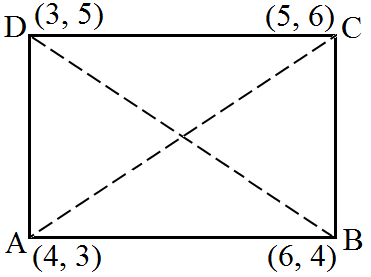
Prove that (4, 3), (6, 4) (5, 6) and (3, 5) are the angular points of a square.
Answer

Let the given points be, A(4, 3), B(6, 4) C(5, 6) and D(3, 5) respectively. Then, Now, $\text{AB}=\sqrt{(6-4)^2+(4-3)^2}$ $=\sqrt{4+1}$ $=\sqrt{5}\ \text{units}$ and $\text{BC}=\sqrt{(5-6)^2+(6-4)^2}$$=\sqrt{1+4}$
$=\sqrt{5}\ \text{units}$ $\text{CD}=\sqrt{(3-5)^2+(5-6)^2}$ $=\sqrt{4+1}$ $=\sqrt{5}\ \text{units}$ $\text{AD}=\sqrt{(3-4)^2+(5-3)^2}$ $=\sqrt{1+4}$ $=\sqrt{5}\ \text{units}$ Thus, AB = BC = CD = AD Diagonal $\text{AC}=\sqrt{(5-4)^2+(6-3)^2}$ $=\sqrt{1+9}$ $=\sqrt{10}\ \text{units}$ Diagonal $\text{BD}=\sqrt{(3-6)^2+(5-4)^2}$ $=\sqrt{9+1}$ $=\sqrt{10}\ \text{units}$ $\therefore$ AB = BC = CD = AD and diagonal AC = diagonal BD. Thus, ABCD is a quadrilateral in which all sides are equal and the diagonal are equal. Hence, ABCD is a square.

Need a full question paper?

Generate a complete, print-ready paper with questions like this in minutes — across 16+ boards, with answer keys.
Start Generating Free

Similar questions

Prove that one and only one out of n, n + 2 and n + 4 is divisible by 3, where n is any positive integer.
In an AP, the first term is -4, the last term is 29 and the sum of all its terms is 150. Find the common difference.
Prove that the angle between the two tangent drawn from an external point to a circle is supplenentary to the angle subtended by the line segments joining the points of contact at the centre.
Construct a $\triangle\text{ABC}$ in which BC = 8cm, $\angle\text{B}=45^\circ$ and $\angle\text{C}=60^\circ.$ Construct another triangle similar to $\triangle\text{ABC}$ such that its sides are $\frac35$ of the corresponding sides of $\triangle\text{ABC}.$
A die is rolled twice. Find the probability that:
5 Will not come up either time.
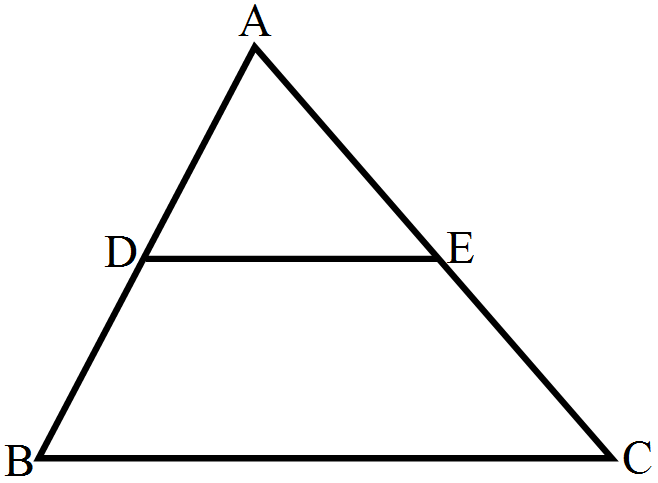
In $\triangle\text{ABC},\text{D}$ and $\text{E}$ are the midpoint of AB and AC respectively. Find the ratio of the areas of $\triangle\text{ADE}$ and $\triangle\text{ABC}.$
On a square cardboard sheet of area $784\ cm^2,$ four congruent circular plates of maximum size are placed such that each circular plate touches the other two plates and each side of the square sheet is tangent to two circular plates. Find the area of the square sheet not covered by the circular plates.
Prove the following identities:
$\frac{\sin\theta+\cos\theta}{\sin\theta-\cos\theta}+\frac{\sin\theta-\cos\theta}{\sin\theta+\cos\theta}=\frac{2}{\big(1-2\cos^2\theta\big)}$
In a class test, the sum of Kamal's marks in Mathematics and English is 40. Had he got 3 marks more in Mathematics and 4 marks less in English, the product of the marks would have been 360. Find his marks in two subjects separately.
The sum of the numerator and denominator of a fraction is 4 more than twice the numerator. If the numerator and denominator are increased by 3, they are in the ratio 2 : 3. Determine the fraction.