Question
Prove that a closed equipotential surface with no charge within itself must enclose an equipotential volume.

Answer

Let us assume that in a closed equipotential surface with no charge the potential is changing from position to position. Let the potential just inside the surface is different to that of the surface causing in a potential gradient $\Big(\frac{\text{dV}}{\text{dr}}\Big)$ It means $\text{E}\neq0$ electric field comes into existence, which is given by as $\text{E}=-\frac{\text{dV}}{\text{dr}}$ It means there will be field lines pointing inwards or outwards from the surface. These lines cannot be again on the surface, as the surface is equipotential. It is possible only when the other end of the field lines are originated from the charges inside. This contradicts the original assumption. Hence, the entire volume inside must be equipotential.

Need a full question paper?

Generate a complete, print-ready paper with questions like this in minutes — across 16+ boards, with answer keys.
Start Generating Free

Similar questions

Why is the diffraction of sound waves more evident in daily experience than that of light wave?
A man uses a concave mirror for shaving. He keeps his face at a distance of 25cm from the mirror and gets an image which is 1.4 times enlarged. Find the focal length of the mirror.
Explain the refraction of a plane wave by
(a) a thin prism
(b) a convex lens and
(c) reflection of a plane wave by a concave mirror.
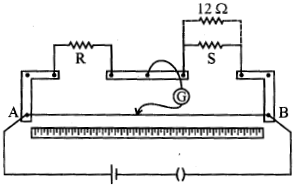
In a meter bridge, the null point is found at a distance of 40 cm from A. If a resistance of 12 Ω is connected in parallel with S, the null point occurs at 50.0 cm from. Determine the values of R and S.
A 5.0 diopter lens forms a virtual image which is 4 times the object placed perpendicularly on the principal axis of the lens. Find the distance of the object from the lens.
Can we have magnetic hysteresis in paramagnetic or diamagnetic substances?
The gravitational force acting on a particle of 1g due to a similar particle is equal to $6.67 \times 10^{-17}N.$ Calculate the separation between the particles.
A dumb-bell consists of two identical small balls of mass $\frac{1}{2}\text{kg}$ each connected to the two ends of a 50cm long light rod. The dumb-bell is rotating about a fixed axis through the centre of the rod and perpendicular to it at an angular speed of 10rad/s. An impulsive force of average magnitude 5.0N acts on one of the masses in the direction of its velocity for 0.10s. Find the new angular velocity of the system.
On the basis of the charging of capacitor, clarify that there is something missing in the Ampere circuital law.
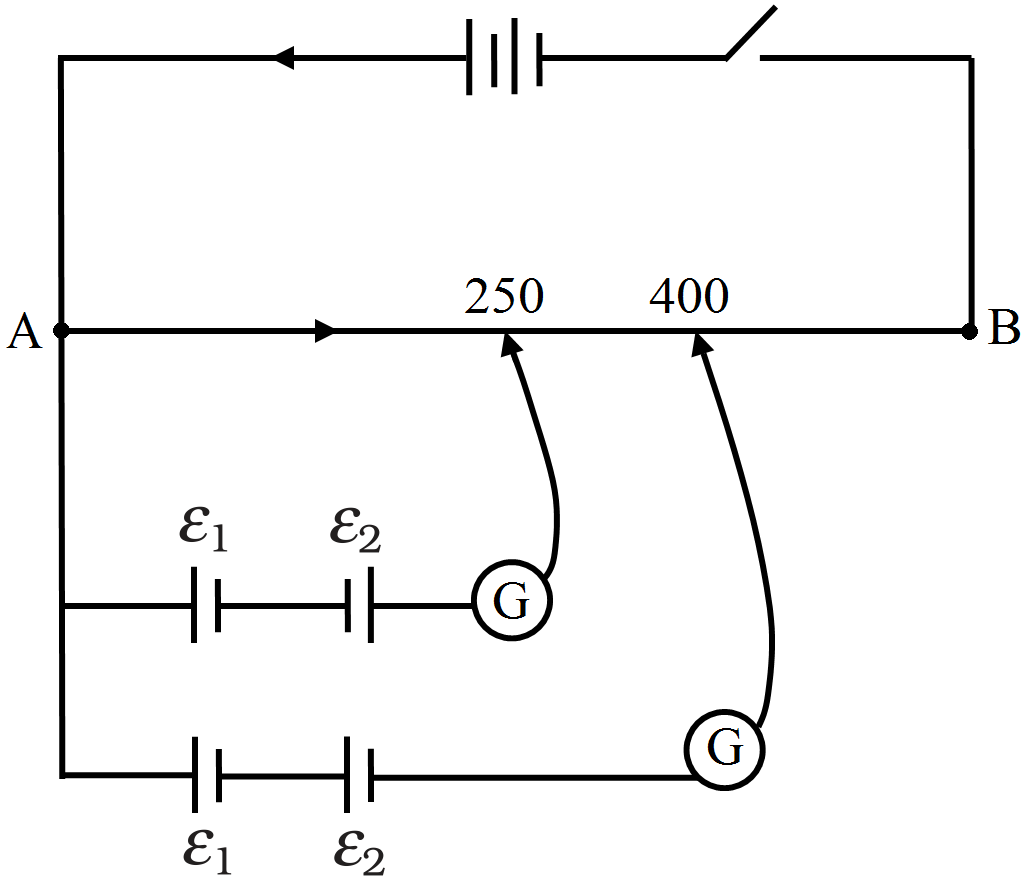
Two primary cells of emfs wire $\varepsilon_1$ and $\varepsilon_2(\varepsilon_1>\varepsilon_2)$ are connected to a potentiometer wire AB as shown in fig. If the balancing lengths for the two combinations of the cells are 250cm and 400cm, find the ratio of $\varepsilon_1$ and $\varepsilon_2.$