Question
Prove that a necessary and sufficient condition for three vectors $\vec{\text{a}},\ \vec{\text{b}}$ and $\vec{\text{c}}$ to be coplanar is that there exist scalars l, m, n not all zero simultaneously such that $\text{l}\vec{\text{a}}+\text{m}\vec{\text{b}}+\text{n}\vec{\text{c}}=\vec0$.
Answer

Necessary Condition: Let $\vec{\text{a}},\ \vec{\text{b}},\ \vec{\text{c}}$ are three coplanar vectors. Then one of them can be expressed as the linear combination of other two vectors. Let, $\vec{\text{c}}=\text{x}\vec{\text{a}}+\text{y}\vec{\text{b}}$ $\text{x}\vec{\text{a}}+\text{y}\vec{\text{b}}-\vec{\text{c}}=0$ Put $\text{x}=1,\ \text{y}=\text{m},\ (-1)=\text{n}$$\text{l}\vec{\text{a}}+\text{m}\vec{\text{b}}+\text{n}\vec{\text{c}}=0$
Thus, if $\vec{\text{a}},\ \vec{\text{b}},\ \vec{\text{c}}$ are coplanar vectors, then there exist scalars l, m, n $\text{l}\vec{\text{a}}+\text{m}\vec{\text{b}}+\text{n}\vec{\text{c}}=0$ Such that l, m, n are not all zero simultaneously. Sufficient Condition: Let $\vec{\text{a}},\ \vec{\text{b}},\ \vec{\text{c}}$ be three vectors such that there exist scalars l, m, n not all zero simultaneously satisfying $\text{l}\vec{\text{a}}+\text{m}\vec{\text{b}}+\text{n}\vec{\text{c}}=0$ $\text{l}\vec{\text{a}}+\text{m}\vec{\text{b}}+\text{n}\vec{\text{c}}=0$ $\text{n}\vec{\text{c}}=-\text{l}\vec{\text{a}}-\text{m}\vec{\text{b}}$ Dividing by n, both the sides $\frac{\text{n}\vec{\text{c}}}{\text{n}}=\frac{-\text{l}\vec{\text{a}}}{\text{n}}-\frac{\text{m}\vec{\text{b}}}{\text{n}}$ $\vec{\text{c}}=\Big(-\frac{\text{l}}{\text{n}}\Big)\vec{\text{a}}+\Big(-\frac{\text{m}}{\text{n}}\Big)\vec{\text{b}}$ $\vec{\text{c}}$ is a linear combination of $\vec{\text{a}} \text{ and }\vec{\text{b}}$ Hence, $\vec{\text{a}},\ \vec{\text{b}},\ \vec{\text{c}}$ are coplanar vectors.

Need a full question paper?

Generate a complete, print-ready paper with questions like this in minutes — across 16+ boards, with answer keys.

Start Generating Free

Similar questions

A small firm manufacturers items $A$ and $B.$ The total number of items $A$ and $B$ that it can manufacture in a day is at the most $24.$ Item A takes one hour to make while item $B$ takes only half an hour. The maximum time available per day is $16$ hours. If the profit on one unit of item $A$ be Rs. $300$ and one unit of item $B$ be Rs. $160,$ how many of each type of item be produced to maximize the profit? Solve the problem graphically.
Evaluate the following intregals:
$\int\frac{2\text{x}^2+1}{\text{x}^2(\text{x}^2+4)}\ \text{dx}$
Solve the following equation for x:
$\tan^{-1}\frac{1}{4}+2\tan^{-1}\frac{1}{5}+\tan^{-1}\frac{1}{6}+\tan^{-1}\frac{1}{\text{x}}=\frac{\pi}{4}$
Find the particular solution of the following differential equation;
$\frac{\text{dx}}{\text{dy}} = 1 + x^2 + y^2 + x^2y^2, $ given that $y = 1$ when $x = 0$.
The pressure p and the volume $v$ of a gas are connected by the relation $pv^{1.4} =$ const. Find the percentage error in p corresponding to a decrease of $1/2\%$ in $v.$
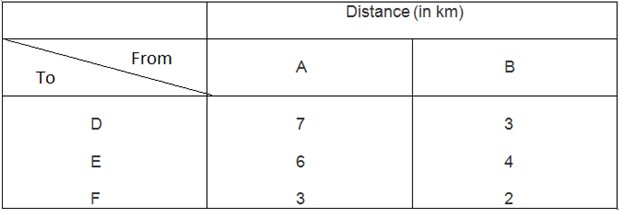
An oil company has two depots, $A$ and $B$, with capacities of $7000$ litres and $4000$ litres respectively. The company is to supply oil to three petrol pumps, $D, E, F$ whose requirements are $4500, 3000$ and $3500$ litres respectively. The distance (in km) between the depots and petrol pumps is given in the following table:

Assuming that the transportation cost per km is Rs. $1.00$ per litre, how should the delivery be scheduled in order that the transportation cost is minimum?
If $\text{P}=\begin{bmatrix}\text{x}&0&0\\0&\text{y}&0\\0&0&\text{z}\end{bmatrix}$ and $\text{Q}=\begin{bmatrix}\text{a}&0&0\\0&\text{b}&0\\0&0&\text{c}\end{bmatrix},$ prove that $\text{PQ}=\begin{bmatrix}\text{xa}&0&0\\0&\text{y}\text{b}&0\\0&0&\text{zc}\end{bmatrix}=\text{QP}$
Find the equation of a curve passing through origin and satisfying the differential equation $(1+\text{x}^2)\frac{\text{dy}}{\text{dx}}+2\text{xy}=4\text{x}^2.$
$\text{If (ax + b)} \text{e}^{\text{y/x}} = \text{x},\text{then show that}$
$\text{x}^{3} \bigg(\frac{\text{d}^{2}\text{y}}{\text{dx}^{2}}\bigg) = \bigg(\text{x}\frac{\text{dy}}{\text{dx}}- \text{y}\bigg)^{2} $
Find the points on the curve $y = 3x^2 - 9x + 8$ at which the tangents are equally inclined with the axes.