Question
Prove that:$\Big(\frac{1}{\text{x}^{\text{a}-\text{b}}}\Big)^{\frac{1}{\text{a}-\text{c}}}\times\Big(\frac{1}{\text{x}^{\text{b}-\text{c}}}\Big)^{\frac{1}{\text{b}-\text{a}}}\times\Big(\frac{1}{\text{x}^{\text{c}-\text{a}}}\Big)^{\frac{1}{\text{c}-\text{b}}}=1$
Answer

$\Big(\frac{1}{\text{x}^{\text{a}-\text{b}}}\Big)^{\frac{1}{\text{a}-\text{c}}}\times\Big(\frac{1}{\text{x}^{\text{b}-\text{c}}}\Big)^{\frac{1}{\text{b}-\text{a}}}\times\Big(\frac{1}{\text{x}^{\text{c}-\text{a}}}\Big)^{\frac{1}{\text{c}-\text{b}}}=1$$=\big(\text{x}\big)^{\frac{1}{(\text{a}-\text{b})}\times\frac{1}{(\text{a}-\text{c})}}\times=\big(\text{x}\big)^{\frac{1}{(\text{b}-\text{c})}\times\frac{1}{(\text{b}-\text{a})}}\times\big(\text{x}\big)^{\frac{1}{(\text{c}-\text{a})}\times\frac{1}{(\text{c}-\text{b})}}$
$=\big(\text{x}\big)^{\frac{1}{(\text{a}-\text{b})(\text{a}-\text{c})}+\frac{1}{(\text{b}-\text{c})(\text{b}-\text{a})}+\frac{1}{(\text{c}-\text{a})(\text{c}-\text{b})}}$
$$$$$$$=\big(\text{x}\big)^{\frac{1}{(\text{a}-\text{b})(\text{c}-\text{a})}-\frac{1}{(\text{b}-\text{c})(\text{a}-\text{b})}-\frac{1}{(\text{c}-\text{a})(\text{b}-\text{c})}}$
$=\big(\text{x}\big)^{\frac{-(\text{b}-\text{c})-(\text{c}-\text{a})-(\text{a}-\text{b})}{(\text{a}-\text{b})(\text{b}-\text{c})(\text{c}-\text{a})}}$
$=\big(\text{x}\big)^{\frac{-\text{b}+\text{c}-\text{c}+\text{a}-\text{a}+\text{b}}{(\text{a}-\text{b}(\text{b}-\text{c})(\text{c}-\text{a})}}$
$=\text{x}^0$
$=1$
$=\text{R.H.S}$

Need a full question paper?

Generate a complete, print-ready paper with questions like this in minutes — across 16+ boards, with answer keys.

Start Generating Free

Similar questions

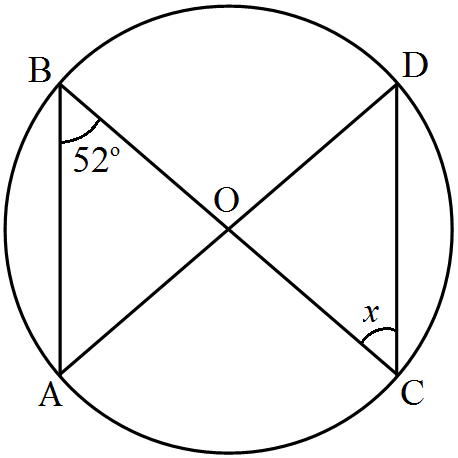
If O is the centre of the circle, find the value of x in the following figure:
Express the following decimals in the form $\frac{\text{p}}{\text{q}},$ where p, q are integers and $\text{q}\neq0.$$1.3\overline{23}$
Read the following passage, write the appropriate amount in the boxes and discuss.
Govind, who is a dry land farmer from Shiralas has a $5$ acre field. His family includes his wife, two children and his old mother. He borrowed one lakh twenty five thousand rupees from the bank for one year as agricultural loan at 10 p.c.p.a. He cultivated soyabean in x acres and cotton and tur in y acres. The expenditure he incurred was as follows :
He spent $₹10,000$ on seeds. The expenses for fertilizers and pesticides for the soyabean crop was$ ₹ 2000x$ and $₹ 4000x^2$ were spent on wages and cultivation of land. He spent ₹ 8000y on fertilizers and pesticides and ₹ 9000y2 for wages and cultivation of land for the cotton and tur crops.Let us write the total expenditure on all the crops by using variables x and y.
$₹ 10000 + 2000x + 4000\times 2 + 8000y + 9000y^2$
He harvested $5 x^2$ quintals soyabean and sold it at $₹ 2800$ per quintal. The cotton crop yield was $\frac{5}{3} y ^2$ quintals which fetched $₹ 5000$ per quintal.
The tur crop yield was $4y$ quintals and was sold at $₹ 4000$ per quintal. Write the total income in rupees that was obtained by selling the entire farm produce, with the help of an expression using variables x and y.
Solve the following equations:$4^{2\text{x}}=(\sqrt[3]{16})^{\frac{-6}{\text{y}}}=(\sqrt{8})^2$
In a $\triangle\text{ABC}$ median AD is produced to x such that AD = DX. Prove that ABXC is a parallelogram.
Express the following decimals in the form $\frac{\text{p}}{\text{q}},$ where p, q are integers and $\text{q}\neq0.$$0.00\overline{32}$
Following $10$ observations are arranged in ascending order as follows. $2, 3 , 5 , 9, x + 1, x + 3, 14, 16, 19, 20.$ If the median of the data is $11,$ find the value of $x.$
Numbers 50, 42, 35, 2x + 10, 2x - 8, 12, 11, 8 are written in descending order and their median is 25, find x.
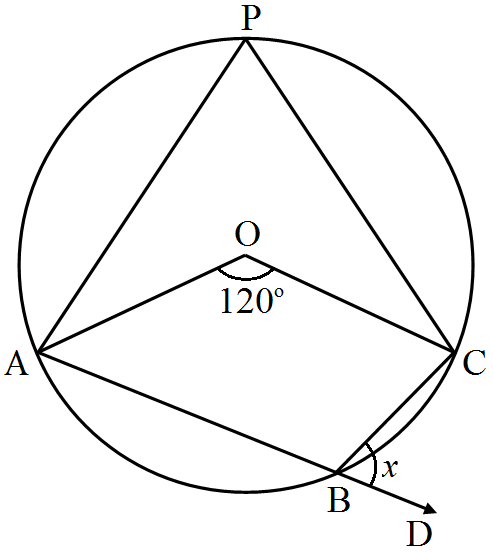
If O is the centre of the circle, find the value of x in the following figure:
Using the remainder theorem, find the remainder, when $p(x)$ is divided by $g(x)$, where,
$p(x)=x^3-6 x^2+9 x+3, g(x)=x-1$.