Question
Prove that closed argon pipe produced only odd harmonics whereas both odd and even harmonic are produced in an open argon pipe.

Answer

SELF

Need a full question paper?

Generate a complete, print-ready paper with questions like this in minutes — across 16+ boards, with answer keys.
Start Generating Free

Similar questions

Water leaks out from an open tank through a hole of area 2mm2 in the bottom. Suppose water is filled up to a height of 80cm and the area of cross-section of the tank is 0.4m2. The pressure at the open surface and at the hole are equal to the atmospheric pressure. Neglect the small velocity of the water near the open surface in the tank.
  1. Find the initial speed of water coming out of the hole.
  2. Find the speed of water coming out when half of water has leaked out.
  3. Find the volume of water leaked out during a time interval dt after the height remained is h. Thus find the decrease in height dh in terms of h and dt.
  4. From the result of part c find the time required for half of the water to leak out.
An aircraft executes a horizontal loop at a speed of 720km/h with its wings banked at 15°. What is the radius of the loop?
A body weighing 10g has a velocity of 6cm/s-1 after one second of its starting from mean position. If the time period is 6s, then find the kinetic energy, potential energy and the total energy.
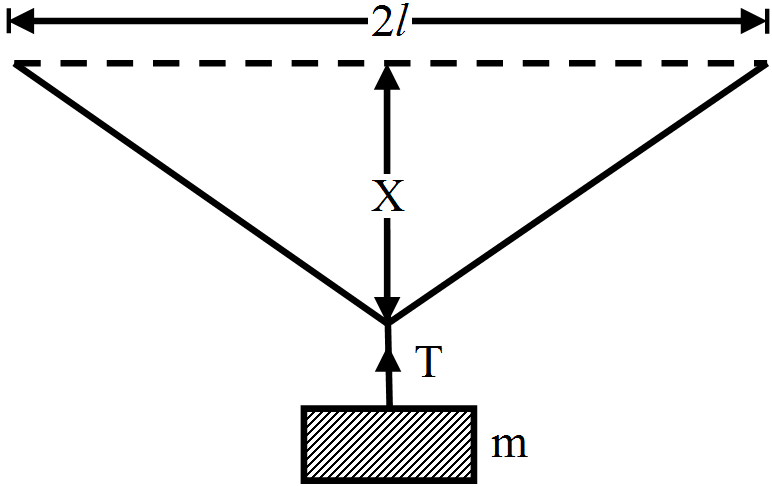
A steel wire of length 2l and cross-sectional area A is stretched within elastic limit as shown in figure. Calculate the strain and stress in the wire.

Write a labelled diagram of resonance tube and explain it. With its help establish formulas to determine the velocity of sound.
OR
Make a labelled diagram of resonance tube and describe its structure and establish the formula to find the velocity of sound at room temperature.
A particle of mass m and charge q is released from the origin in a region in which the electric field and magnetic field are given by
$\overrightarrow{\text{B}}=-\text{B}_0\overrightarrow{\text{j}}$ and $\overrightarrow{\text{E}}=\text{E}_0\overrightarrow{\text{k}}.$ Find the speed of the particle as a function of its z-coordinate.
Consider a rectangular block of wood moving with a velocity v0 in a gas at temperature T and mass density ρ. Assume the velocity is along x-axis and the area of cross-section of the block perpendicular to v0 is A. Show that the drag force on the block is $4\rho\text{ Av}_0\sqrt{\frac{\text{KT}}{\text{m}}}$ where m is the mass of the gas molecule.
Define banking of roads. Derive an expression for maximum velocity of a car on a banked circular road having co-efficient of friction $\mu.$

OR

A man of mass 70kg stands on a weighing scale in a lift which is moving,

  1. Upwards with a uniform speed of 10ms-1.
  2. Downward with a uniform acceleration of 5ms-2.
  3. Upward with a uniform acceleration of 5ms-2 What would be the readings on the scale in each case?
  4. What would be the reading if the lift mechanism failed and it hurtled down freely under gravity?
A particle of mass 100g moving at an initial speed u collides with another particle of same mass kept initially at rest. If the total kinetic energy becomes 0.2J after the collision, what could be the minimum and the maximum value of u.
A particle of mass 0.1kg has an initial speed of 4ms-1 at a point A on a rough horizontal road. The coefficient of friction, between the object and the road is 0.15. The particle moves to a point B at a distance of 2m from A. What is the speed of the particle B? (Take g = 10ms-2)