Question
Prove that each angle of an equilateral triangle is$ 60^\circ .$

Answer

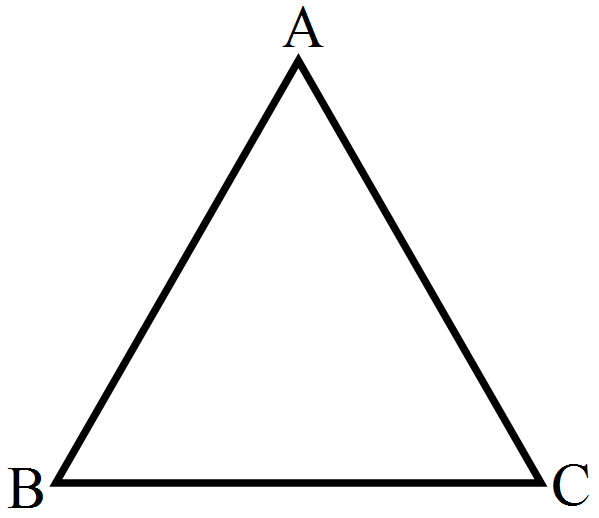
Given to prove each angle of an equilateral triangle is 60°. Let us consider an equilateral triangle ABC. Such that AB = BC = CA Now, AB = BC $\angle\text{A}=\angle\text{C}\ ....(\text{i})$ [Opposite angles to equal sides are equal] And $\text{BC}=\text{AC}$ $\angle\text{B}=\angle\text{A}\ ...(\text{ii)}$ From (i) and (ii), we get $\angle\text{A}=\angle\text{B}=\angle\text{C}\ ...(\text{iii})$
We know that Sum of angles in a triangle = 180 $\angle\text{A}+\angle\text{B}+\angle\text{C}=180$
$\angle\text{A}+\angle\text{A}+\angle\text{A}=180$
$3\angle\text{A}=60$
$\angle\text{A}=60$
$\angle\text{A}=\angle\text{B}=\angle\text{C}=60$
Hence, each angle of an equilateral triangle is $60^\circ .$

Need a full question paper?

Generate a complete, print-ready paper with questions like this in minutes — across 16+ boards, with answer keys.
Start Generating Free

Similar questions

The adjacent sides of a parallelogram $ABCD$ measure $34\ cm$ and $20\ cm$, and the diagonal $AC$ measures $42\ cm$. Find the area of parallelogram.
In a rhombus $ABCD$ show that diagonal $AC$ bisects $\angle\text{A}$ as well as $\angle\text{C}$ and diagonal $BD$ bisects $\angle\text{B}$ as well as $\angle\text{D}.$
A, B and C are three points on a circle. Prove that the perpendicular bisectors of AB, BC and CA are concurrent.
A ship sails out to an island at the rate of $15\ km/hr$ and sails back to the starting point at $10\ km/hr$. Find the average sailing speed for the whole journey.
The difference between inside and outside surfaces of a cylindrical tube is $14\ cm$ long is $88\ sq$. cm. If the volume of the tube is $176$ cubic $cm$, Find the inner and outer radii of the tube.
Visualize the representation of $3.765$ on the number line using successive magnification.
The dimension of a room are $(9 m \times 8 m \times 6.5 m)$. It has one door of dimension $(2 m \times 1.5 m)$ and two window, each of dimension $(1.5 \times 1 m)$. Find the cost of whitewashing the walls at $₹ 25$ per square metre.
A conical tent is $10m$ high and the radius of its base is $24\ m$. Find the slant height of the tent. If the cost of $1m^2$ canvas is $₹ 70$, find the cost of canvas required to make the tent. $\Big(\text{Use}\ \pi=\frac{22}{7}\Big).$
Ravish wanted to make a temporary shelter for his car by making a box-like structure with the tarpaulin that covers all the four sides and the top of the car (with the front face of a flap which can be rolled up). Assuming that the stitching margins are very small, and therefore negligible, how many tarpaulins would be required to make the shelter of height $2.5\ m$ with base dimensions $4m \times 3m?$