Question
Prove that energy remains conserved in electromagnetic induction.

Answer

SELF

Need a full question paper?

Generate a complete, print-ready paper with questions like this in minutes — across 16+ boards, with answer keys.
Start Generating Free

Similar questions

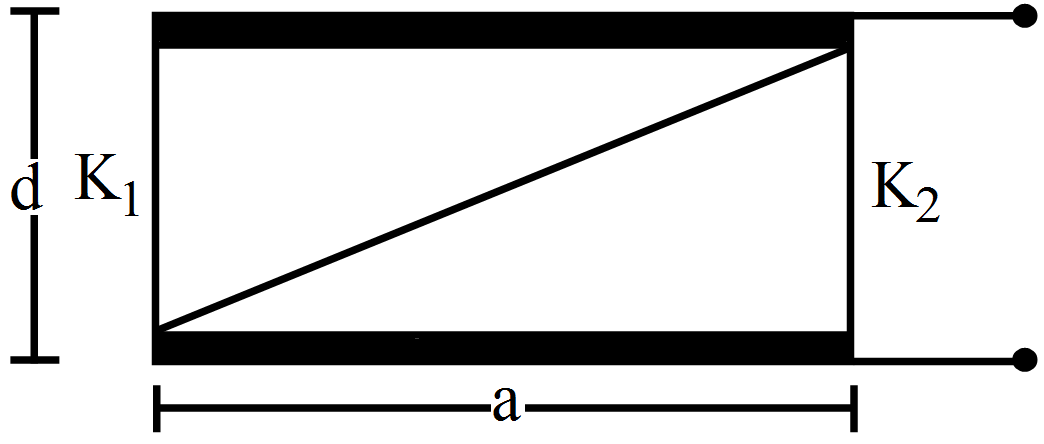
A capacitor is formed by two square metal$-$plates of edge a, separated by a distance $d.$ Dielectrics of dielectric constants $K_1$ and $K_2$ are filled in the gap as shown in figure. Find the capacitance.
A solenoid is connected to a battery so that a steady current flows through it. If an iron core is inserted into the solenoid, will the current increase or decrease? Explain.
A car moving at $108\ km/h$ finds another car in front of it going in the same direction at $72\ km/h.$ The first car sounds a horn that has a dominant frequency of $800\ Hz.$ What will be the apparent frequency heard by the driver in the front car? Speed of sound in air $= 330m/s.$
A hot body placed in a surrounding of temperature $\theta_0$ obeys Newton's law of cooling $\frac{\text{d}\theta}{\text{dt}}=-\text{k}(\theta-\theta_0).$ Its temperature at $t = 0$ is $\theta_1.$ The specific heat capacity of the body is s and its mass is m. Find,
  1. The maximum heat that the body can lose.
  2. The time starting from $t = 0$ in which it will lose $90\%$ of this maximum heat.
A permanent magnet in the shape of a thin cylinder of length $10 \ cm$ has $M = 106A/m.$ Calculate the magnetisation current $I_M.$
A uniform magnetic field B exist in a region. An electron projected perpendicular to the field goes in a circle. Assuming Bohr's quantization rule for angular momentum, calculate (a) the smallest possible radius of the electron (b) the radius of the nth orbit and (c) the minimum possible speed of the electron.
Suppose that the radius of cross-section of the wire used in the previous problem is r. Find the increase in the radius of the loop if the magnetic field is switched off. Young's modulus of the material of the wire is Y.
Derive the lens formula,  $\frac{1}{\text{f}} = \frac{1}{\text{v}} - \frac{1}{\text{u}}$ for a concave lens, using the necessary ray diagram.
Two lenses of powers 10 D and – 5 D are placed in contact.
  1. Calculate the power of the new lens.
  2. Where should an object be held from the lens, so as to obtain a virtual image of magnification 2?
What is nuclear fusion? How is energy produced in the sun by this process? Explain with necessary equations.
Consider a straight piece of length x of a wire carrying a current i. Let P be a point on the perpendicular bisector of the piece, situated at a distance d from its middle point. Show that for d >> x, the magnetic field at P varies as $\frac{1}{\text{d}^2}$ whereas ford d << x, it varies as $\frac{1}{\text{d}}.$