Question
Prove that $\frac{1+\sec A }{\sec A }=\frac{\sin ^2 A }{1-\cos A }$

Answer

$ \text { L.H.S }=\frac{1+\sec A}{\sec A}$
$ =\frac{1}{\sec A}+\frac{\sec A}{\sec A}$
$ =\cos A+1$
$ =(1+\cos A) \times \frac{1-\cos A}{1-\cos A}$
$ =\frac{1-\cos ^2 A}{1-\cos A}$
$=\frac{\sin ^2 A}{1-\cos A}  ........ \left[\begin{array}{l}\because \sin ^2 A+\cos ^2 A=1 \\ \therefore 1-\cos ^2 A=\sin ^2 A\end{array}\right]$
$ =\text { R.H.S }$
$ \therefore \frac{1+\sec A}{\sec A}=\frac{\sin ^2 A}{1-\cos A}$

Need a full question paper?

Generate a complete, print-ready paper with questions like this in minutes — across 16+ boards, with answer keys.
Start Generating Free

Similar questions

Find the ratio in which the point P(m, 6) divides the join of A(-4, 3) and B(2, 8). Also find the value of m.
The difference of two natural numbers is $3$ and the difference of their reciprocals is $\frac{3}{28}.$ Find the numbers.
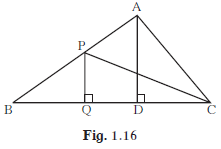
In adjoining figure PQ ⊥ BC, AD ⊥ BC then find following ratios.

(i) $\frac{ A (\Delta PQB )}{ A (\triangle PBC )}$
(ii) $\frac{ A (\Delta PBC )}{ A (\Delta ABC )}$
(iii) $\frac{ A (\Delta ABC )}{ A (\triangle ADC )}$
(iv) $\frac{ A (\Delta ADC )}{ A (\Delta PQC )}$
The line segment AB is divided into five congruent parts at P, Q, R and S suchthat A-P-Q-R-S-B. If point Q(12, 14) and
S(4, 18) are given find thecoordinates of A, P, R,B.

Write the coordinates of a point on x-axis which is equidistant from the points $(-3, 4)$ and $(2, 5)$.
The following is the cummulative frequency distribution (of less than type) of $1000$ persons each of age $20$ years and above. Determine the mean age.
Age below (in year):
$30$
$40$
$50$
$60$
$70$
Number of persons:
$100$
$220$
$350$
$750$
$950$
What is the largest number that divides 626, 3127 and 15628 and leaves remainders of 1, 2 and 3 respectively.
Draw a circle of radius 3.6 cm. Draw a tangent to the circle at any point on it without using the centre.

Prove the following identities:
$\sin\theta(1+\tan\theta)+\cos\theta(1+\cot\theta)=(\sec\theta+\text{cosec }\theta)$
Prove the following trigonometric identities.
$\frac{\sin\theta-\cos\theta+1}{\sin\theta+\cos\theta-1}=\frac{1}{\sec\theta-\tan\theta}$