Question
Prove that $\frac{\sec A }{\tan A +\cot A }=\sin A$

Answer

$\text { L.H.S }=\frac{\sec A }{\tan A +\cot A }$
$=\frac{\sec A }{\frac{\sin A }{\cos A }+\frac{\cos A }{\sin A }}$
$=\frac{\sec A }{\frac{\sin ^2 A +\cos ^2 A }{\cos A \sin A }}$
$=\frac{\sec A }{\frac{1}{\cos A \sin A }} \cdots \ldots \cdot\left[\cdot \sin ^2 A +\cos ^2 A =1\right]$
$=\sec A \cos A \sin A$
$=\frac{1}{\cos A } \times \cos A \sin A$
$=\sin A$
$=\text { R.H.S. }$
$\therefore \frac{\sec A }{\tan A +\cot A }=\sin A $

Need a full question paper?

Generate a complete, print-ready paper with questions like this in minutes — across 16+ boards, with answer keys.
Start Generating Free

Similar questions

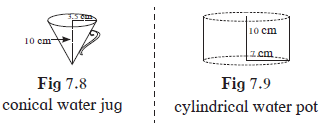
Observe the measures of pots in figure 7.8 and 7.9. How many jugs of water can the cylindrical pot hold?
Solve the following quadratic equation by completing the square method.
$x^2+2 x-5=0$
Mrs. Sita invested ₹ 92,124 in shares of face value ₹ 10 each at ₹ 90 market value. She paid 2 % brokerage and 18 % GST on it. Company declared a dividend of 60 % on then. Find her dividend.
Draw a circle of radius 4.2 cm. Draw arc PQ measuring 120°. Draw a tangent to the circle from point P and point Q
If the face value of both the shares is same, then which investment out of the following is more profitable?
Company A : dividend 16%, MV = Rs. 80, Company B : dividend 20%, MV = Rs. 120.
Find the volume of a solid in the form of a right circular cylinder with hemi-spherical ends whose total length is 2.7m and the diameter of each hemi-spherical end is 0.7m.
Solve the following system of equations by the method of cross-multiplication:
ax + by = a - b,
bx - ay = a + b.
Decide whether 301 is term of given sequence 5,11,17,23,.......
Activity :- Here, d = ____ therefore this sequence is an A.P.
a= 5, d= ____
Let nth term of this A.P. be 301.
$t _{ n }$ = a + (n-1) ____
301 = 5 + (n-1)×6
301 = 6n-1
n =$\frac{302}{6}$ = ____
But n is not positive integer
Therefore, 301 is ____ the term of sequence 5,11,17,23.........
Find the sum of the first $25$ terms of an A.P. whose $n^{\text {th }}$ term is given by $a_n=7-3 n$.
Show that the sum of all odd integers between $1$ and $1000$ which are divisible by $3$ is $83667$.