Question
Prove that:
$\frac{\sin\text{A}\sin2\text{A}+\sin3\text{A}\sin6\text{A}}{\sin\text{A}\cos2\text{A}+\sin3\text{A}\cos6\text{A}}=\tan5\text{A}$
Answer

We have,
$\text{LHS}=\frac{\sin\text{A}\sin2\text{A}+\sin3\text{A}\sin6\text{A}}{\sin\text{A}\cos2\text{A}+\sin3\text{A}\cos6\text{A}}$
$=\ \frac{2[\sin\text{A}\sin2\text{A}+\sin3\text{A}\sin6\text{A}]}{2[\sin\text{A}\cos2\text{A}+\sin3\text{A}\cos6\text{A}]}$
$=\ \frac{2\sin2\text{A}\sin\text{A}+2\sin6\text{A}\sin3\text{A}}{2\cos2\text{A}\sin\text{A}+2\cos6\text{A}\sin3\text{A}}$
$=\ \frac{\cos(2\text{A}-\text{A})-\cos(2\text{A}+\text{A})+\cos(6\text{A}-3\text{A})-\cos(6\text{A}+3\text{A})}{\sin(2\text{A}+\text{A})-\sin(2\text{A}-\text{A})+\sin(6\text{A}+3\text{A})+\sin(6\text{A}-3\text{A})}$
$=\ \frac{\cos\text{A}-\cos3\text{A}+\cos3\text{A}-\cos9\text{A}}{\sin3\text{A}-\sin\text{A}+\sin9\text{A}-\sin3\text{A}}$
$=\ \frac{\cos\text{A}-\cos9\text{A}}{\sin9\text{A}-\sin\text{A}}$
$=\ \frac{-[\cos9\text{A}-\cos\text{A}]}{\sin9\text{A}-\sin\text{A}}$
$=\ \frac{-\Big(-2\sin\Big(\frac{9\text{A}+\text{A}}{2}\Big)\times\sin\Big(\frac{9\text{A}-\text{A}}{2}\Big)\Big)}{2\sin\Big(\frac{9\text{A}-\text{A}}{2}\Big)\times\cos\Big(\frac{9\text{A}+\text{A}}{2}\Big)}$
$=\ \frac{\sin5\text{A}\sin4\text{A}}{\sin4\text{A}\cos5\text{A}}$
$=\ \tan5\text{A}$
$=\ \text{RHS}$
$\therefore\ \frac{\sin\text{A}\sin2\text{A}+\sin3\text{A}\sin6\text{A}}{\sin\text{A}\cos2\text{A}+\sin3\text{A}\cos6\text{A}}=\tan5\text{A}$ Hence proved.

Need a full question paper?

Generate a complete, print-ready paper with questions like this in minutes — across 16+ boards, with answer keys.

Start Generating Free

Similar questions

Given $\text{a}_1=\frac{1}{2}\Big(\text{a}_0+\frac{\text{A}}{\text{a}_0}\Big),\text{a}_2=\frac{1}{2}\Big(\text{a}_1+\frac{\text{A}}{\text{a}_1}\Big)$ and $\text{a}_{\text{n}+1}=\frac{1}{2}\Big(\text{a}_\text{n}+\frac{\text{A}}{\text{a}_\text{n}}\Big)$ for $\text{n}\geq2,$ Where a > 0, A > 0. Prove that $\frac{\text{a}_{\text{n}}-\sqrt{\text{A}}}{{\text{a}_{\text{n}}+\sqrt{\text{A}}}}=\Bigg(\frac{\text{a}_{\text{1}}-\sqrt{\text{A}}}{\text{a}_{\text{1}}+\sqrt{\text{A}}}\Bigg)^{2^{\text{n}-1}}$
Find the equation of the straight line perpendicular to $2x - 3y = 5$ and cutting off an intercept $1$ on the positive direction of the $x-$axis.
A card is drawn from a pack of 52 cards. What is the probability that, (i) card is either red or black?

(ii) card is either black or a face card?

Find the equation to the ellipse in the following case:Length of major axis $16$ foci $(0, \pm6)$
Evaluate the following limits:
$\lim _{x \rightarrow \frac{\pi}{6}}\left[\frac{2-\sqrt{3} \cos x-\sin x}{(6 x-\pi)^2}\right]$
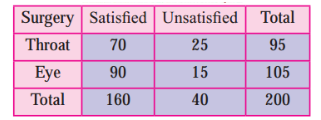
Two hundred patients who had either Eye surgery or Throat surgery were asked whether they were satisfied or unsatisfied regarding the result of their surgery. The following table summarizes their response.

Image

If one person from the 200 patients is selected at random, determine the probability (a) that the person was satisfied given that the person had Throat surgery.

2.that person was unsatisfied given that the person had eye surgery.

3.the person had Throat surgery given that the person was unsatisfied.

Find the numberof observation lying between $\overline{\text{X}}-\text{M.D. }$and $\overline{\text{X}}-\text{M.D. }$ is the mean deviation from the mean.
$34, 66, 30, 38, 44, 50, 40, 60, 42, 51$
Prove the following by the principle of mathematical induction:
$7^{2n} + 2^{3n-3}.3^{n-1} $ is divisible of $25$ for all $\text{n}\in\text{N}$
Find the equation of circle passing through the point of intersection of the lines x + 3y = 0 and 2x – 7y = 0 and whose centre is the point of intersection of lines x + y + 1 = 0 and x – 2y + 4 = 0.
Sum the following series to $n$ terms:
$\frac{1}{1.4}+\frac{1}{4.7}+\frac{1}{7.10}+\ .....$