Question
Prove that in projectile motion, when bodies are projected at angle $\left(45^{\circ}+\phi\right)$ and $\left(45^{\circ}-\phi\right)$ from the horizontal, their horizontal range will be same.

Answer

 We know that by projecting an object at angle $\theta$,
$R=\frac{u^2 \sin 2 \theta}{g}$
But it is given that when object is projected at angle $(45+\phi)$ and $\left(45^{\circ}-\phi\right)$ from the horizontal, their ranges are same.
$
\begin{array}{l}
R_1=\frac{u^2 \sin 2\left(45^{\circ}+\phi\right)}{g} \\
R_1=\frac{u^2 \sin \left(90^{\circ}+2 \phi\right)}{g} \\
R_1=\frac{u^2 \cos 2 \phi}{g}.....(1)
\end{array}
$
similarly,
$
\begin{array}{l}
R_2=\frac{u^2 \sin 2\left(45^{\circ}-\phi\right)}{g} \\
R_2=\frac{u^2 \sin \left(90^{\circ}-2 \phi\right)}{g} \\
R_2=\frac{u^2 \cos 2 \phi}{g}.....(2)
\end{array}
$

From equations (1) and (2), it is clear
$R_1=R_2$
Need a full question paper?

Generate a complete, print-ready paper with questions like this in minutes — across 16+ boards, with answer keys.

Start Generating Free

Similar questions

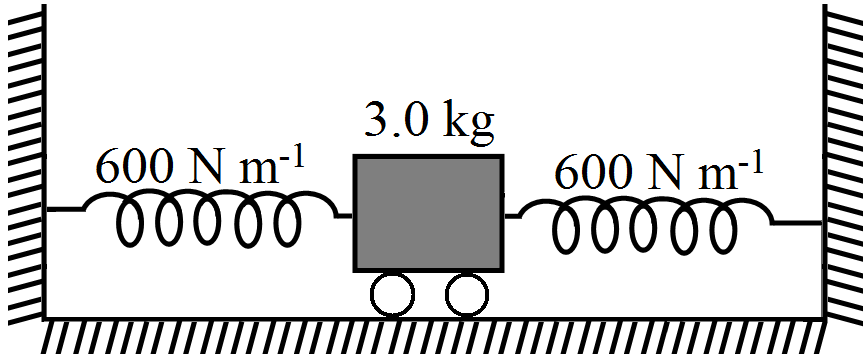
A trolley of mass $3.0\ kg$, as shown in Figure, is connected to two springs, each of spring constant $600Nm^{-1}$. If the trolley is displaced from its equilibrium position by $5.0\ cm$ and released, what is $(a)$ the period of ensuing oscillations, and $(b)$ the maximum speed of the trolley? How much energy is dissipated as heat by the time trolley comes to rest due damping forces?
In Searle's experiment, the diameter of the wire as measured by a screw guage of least count 0.001cm is 0.500cm. The length, measured by a scale of least count 0.1cm is 110.0cm. When a weight of 40N is suspended from the wire, its extension is measured to be 0.125cm by a micrometer of least count 0.001cm. Find the Young's modulus of the material of the wire from this data.
Two small balls A and B, each of mass m, are joined rigidly by a light horizontal rod of length L. The rod is clamped at the centre in such a way that it can rotate freely about a vertical axis through its centre. The system is rotated with an angular speed w about the axis. A particle P of mass m kept at rest sticks to the ball A as the ball collides with it. Find the new angular speed of the rod.
The equation of a wave travelling on a string is : $\text{y}=(0.10\text{mm})\sin\big[(31.4\text{m}^{-1})\text{x}+(314\text{s}^{-1})\text{t}\big].$
  1. In which direction does the wave travel?
  2. Find the wave speed, the wavelength and the frequency of the wave.
  3. What is the maximum displacement and the maximum speed of a portion of the string?
An ideal gas $\Big(\frac{\text{C}_\text{P}}{\text{C}_\text{V}}=\gamma\Big)$ is taken through a process in which the pressure and the volume vary as $p = aV^b$. Find the value of b for which the specific heat capacity in the process is zero.
A simple pendulum of length l and having a bob of mass M is suspended in a car. The car is moving on a circular track of radius R with a uniform speed v. If the pendulum makes small oscillations in a radial direction about its equilibrium position, what will be its time period?
Two wires of different densities but same area of crosssection are soldered together at one end and are stretched to a tension T. The velocity of a transverse wave in the first wire is double of that in the second wire. Find the ratio of the density of the first wire to that of the second wire.
A water particle of mass 10.0mg and having a charge of $1.50 \times 10^{-6}C$ stays suspended in a room. What is the magnitude of electric field in the room? What is its direction?
Two parallel rail tracks run north-south. Train A moves north with a speed $54 km / h ^{-1}$ and $\operatorname{train} B$ moves south with a speed of $90 km / h ^{-1}$. What is the:
i. Velocity of $B$ with respect to $A$ ?
ii. Velocity of ground with respect to B?
iii. Velocity of a monkey running on the roof of train $A$ against its motion (with a speed of $10 km^{-1}$ with respect to train A ) as observed by a man standing on the ground?
OR
Obtain any one equation of motion for constant acceleration using method of calculus.
A train standing at the outer signal of a railway station blows a whistle of frequency $400$ Hz still air. The train begins to move with a speed of $10 m s ^{-1}$ towards the platform. What is the frequency of the sound for an observer standing on the platform? (sound velocity in air $=330 m s ^{-1}$ )