Question
Prove that : $\log_{10} 125 = 3(1 - \log_{10}2).$

Answer

$ \log _{10} 125=3\left(1-\log _{10} 2\right)$
$\text { L.H.S. }=\log _{10} 125$
$\Rightarrow \log _{10} 5 \times 5 \times 5$
$\Rightarrow \log _{10} 5^3$
$\Rightarrow 3 \log _{10} 5 \ldots .(1)$
$\text { R.H.S }=3\left(1-\log _{10} 2\right)$
$\left.\Rightarrow 3 \log _{10} 10-\log _{10} 2\right)$
$\Rightarrow 3 \log _{10}\left(\frac{10}{2}\right)$
$\Rightarrow 3 \log _{10} 5$
From $(1)$ and $(2),$ we have
$\text{L.H.S.} =\text {R. H. S}.$
Hence proved.

Need a full question paper?

Generate a complete, print-ready paper with questions like this in minutes — across 16+ boards, with answer keys.
Start Generating Free

Similar questions

$D, E$ and $F$ are the mid$-$points of the sides $AB, BC$ and $CA$ of an isosceles $\triangle ABC$ in which $AB = BC$. Prove that $\triangle DEF$ is also isosceles.
If $\log 16 = a, \log 9 = b$ and $\log 5 = c,$ evaluate the following in terms of $a, b, c: \log 720$
A certain sum of money amounts to ₹ 7260 in 2 years and to ₹ 7986 in 3 years, interest being compounded annually. Find the rate per cent per annum.
A boy is now one$-$third as old as his father. Twelve years hence he will be half as old as his father. Determine the present ages of the boy and that of his father.
How much will ₹ 12000 amount to in 2 years at compound interest, the rates of interest for the successive years being 10% and 11% respectively?
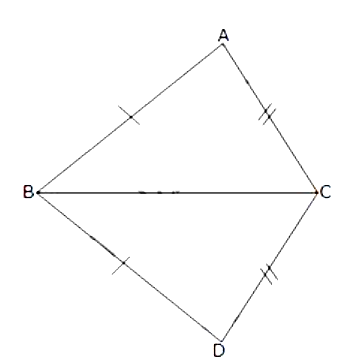
In the given figure, $A B=D B$ and $A C=D C$.

If  $\angle \mathrm{ABD}=58^{\circ}, \angle \mathrm{DBC}=(2 \mathrm{x}-4)^{\circ}, \angle \mathrm{ACB}=\mathrm{y}+15^{\circ} $ and $\angle \mathrm{DCB}=63^{\circ};$ find the values of $x$ and $y.$
If $a=\log \frac{3}{5}, b=\log \frac{5}{4}$ and $c=2 \log \sqrt{\frac{3}{4}}$, prove that $5^{a+b-c}=1$
Two adjacent sides of a parallelogram are 36 cm and 25 cm. If the distance between longer sides is 15cm, find the distance between the shorter sides.
In $\triangle ABC, AB = AC = x, BC = 10\ cm$ and the area of the triangle is $60 \ cm^2$.Find $x.$
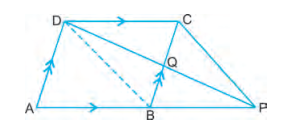
In the adjoining figure, ABCD is a parallelogram. AB is produced to a point P and DP intersects $B C$ at $Q$.
Prove that : $\operatorname{ar}(\triangle APD )=\operatorname{ar}($ quad. $B P C D)$.
Image