Question
Prove that $\sin \theta ( 1 – \tan \theta ) − \cos \theta ( 1 − \cot \theta ) = cosec \theta − \sec \theta$

Answer

$\text { L.H.S }=\sin \theta(1-\tan \theta)-\cos \theta(1-\cot \theta)$
$=\sin \theta\left(1-\frac{\sin \theta}{\cos \theta}\right)-\cos \theta\left(1-\frac{\cos \theta}{\sin \theta}\right)$
$=\sin \theta-\frac{\sin ^2 \theta}{\cos \theta}-\cos \theta+\frac{\cos ^2 \theta}{\sin \theta}$
$=\sin \theta+\frac{\cos ^2 \theta}{\sin \theta}-\frac{\sin ^2 \theta}{\cos \theta}-\cos \theta$
$=\frac{\sin ^2 \theta+\cos ^2 \theta}{\sin \theta}-\left(\frac{\sin ^2 \theta+\cos ^2 \theta}{\cos \theta}\right)$
$=\frac{1}{\sin \theta}-\frac{1}{\cos \theta} \quad \ldots \ldots\left[\because \sin ^2 \theta+\cos ^2 \theta=1\right]$
$=\operatorname{cosec} \theta-\sec \theta$
$=\text { R.H.S }$
$\therefore \sin \theta(1-\tan \theta)-\cos \theta(1-\cot \theta)=\operatorname{cosec} \theta-\sec \theta$

Need a full question paper?

Generate a complete, print-ready paper with questions like this in minutes — across 16+ boards, with answer keys.

Start Generating Free

Similar questions

The sum of $4^{\text {th }}$ and $8^{\text {th }}$ terms of an A.P. is $24$ and the sum of the $6^{\text {th }}$ and $10^{\text {th }}$ terms is $34$ . Find the first term and the common difference of the A.P
Determine the ratio in which the point $(-6, a)$ divides the join of $A(-3, 1)$ and $B(-8, 9)$. Also find the value of a.
Show that the equation $2(a^2 + b^2)x^2 + 2(a + b)x + 1 = 0$ has no real roots, when $\text{a}\neq\text{b}.$
$\triangle PQR \sim \triangle PAB , m \angle P =60^{\circ}, PQ =6 cm, PR =4 cm$. Construct $\triangle PAB$, if $PQ : PA =3: 2$.
During a medical check-up, the number of heartbeats per minute of 30 patients were recorded and summarised as follows:
Number of heartbeats per minute 65-68 68-71 71-74 74-77 77-80 80-83 83-86
Number of patients 2 4 3 8 7 4 2
Mean, median, mode of grouped data, cumulative frequency graph and ogive.
Find the mean heartbeats per minute for these patients, choosing a suitable method.
Determine, by drawing graphs, whether the following system of linear equations has a unique solution or not:
2x - 3y = 6, x + y = 1.
Find the co-ordinates of the points of trisection of the segment joining the points $\mathrm{A}(2,-2)$ and $\mathrm{B}(-7,4)$.(The two points that divide the line segment in three equal parts are called as points of trisection of the segment.)
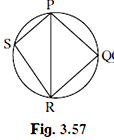
In figure 3.57, $\square PQRS$ is cyclic. side PQ ≅ side RQ. ∠ PSR = 110°, Find-

(1) measure of ∠ PQR
(2) m(arc PQR)
(3) m(arc QR)
(4) measure of ∠ PRQ
Show that the following points are the vertices of a rectangle:
A(0, -4), B(6, 2), C(3, 5) and D(-3, -1)
Two poles of equal heights are standing opposite to each other on either side of the road which is 80m wide. From a point P between them on the road, the angle of elevation of the top of one pole is 60° and the angle of depression from the top of another pole at P is 30°. Find the height of each pole and distances of the point P from the poles.