Question
Prove that:
$\sin\frac{\text{x}}{2}\sin\frac{7\text{x}}{2}+\sin\frac{3\text{x}}{2}\sin\frac{11\text{x}}{2}=\sin2\text{x}\sin5\text{x}.$
Answer

We have,
$\text{LHS}=\sin\frac{\text{x}}{2}\sin\frac{7\text{x}}{2}+\sin\frac{3\text{x}}{2}\sin\frac{11\text{x}}{2}$
$=\ \frac{1}{2}\Big[2\sin\frac{7\text{x}}{2}\sin\frac{\text{x}}{2}+2\sin\frac{110}{2}\sin\frac{3\text{x}}{2}\Big]$
$=\ \frac{1}{2}\Big[\cos\Big(\frac{7\text{x}}{2}-\frac{\text{x}}{2}\Big)-\cos\Big(\frac{7\text{x}}{2}+\frac{\text{x}}{2}\Big)+\cos\Big(\frac{110}{2}-\frac{3\text{x}}{2}\Big)-\cos\Big(\frac{110}{2}+\frac{3\text{x}}{2}\Big)\Big]$
$=\ \frac{1}{2}\Big[\cos\frac{60}{2}-\cos\frac{80}{2}+\cos\frac{80}{2}-\cos\frac{140}{2}\Big]$
$=\ \frac{1}{2}[\cos3\text{x}-\cos4\text{x}+\cos4\text{x}-\cos7\text{x}]$
$=\ \frac{1}{2}[\cos3\text{x}-\cos7\text{x}]$
$=\ \frac{-1}{2}[\cos7\text{x}-\cos3\text{x}]$
$=\ \frac{-1}{2}\Big[-2\sin\Big(\frac{7\text{x}+3\text{x}}{2}\Big)\sin\Big(\frac{7\text{x}-3\text{x}}{2}\Big)\Big]$
$=\ \sin\frac{10\text{x}}{2}\sin\frac{4\text{x}}{2}$
$=\ \sin5\text{x}\sin2\text{x}$
$=\ \sin2\text{x}\sin5\text{x}$
$=\ \text{RHS}$
$\therefore\ \sin\frac{\text{x}}{2}\sin\frac{7\text{x}}{2}+\sin\frac{3\text{x}}{2}\sin\frac{110}{2}=\sin2\text{x}\sin5\text{x}.$
Hence proved.

Need a full question paper?

Generate a complete, print-ready paper with questions like this in minutes — across 16+ boards, with answer keys.

Start Generating Free

Similar questions

Prove that:
$(\cos\text{x}+\cos\text{y})^2+(\sin\text{x}-\sin\text{y})^2=4\cos^2\frac{\text{x}+\text{y}}{2}$
Evaluate the following limit:
$\lim\limits_{\text{x}\rightarrow2}\bigg\{\frac{1}{\text{x}-2}-\frac{2(2\text{x}-3)}{\text{x}^2-3\text{x}^2+2\text{x}}\bigg\}$
Solve the following equations:
$4\sin\text{x}\cos\text{x}+2\sin\text{x}+2\cos\text{x}+1=0$
How many different words can be formed from the letters of the word 'GANESHPURI'? In how many of these words:
  1. The letter G always occupies the first place?
  2. The letters P and I respectively occupy first and last place?
  3. The vowels are always together?
  4. The vowels always occupy even places?
Prove the following by the principle of mathematical induction:
$\frac{1}{3.5}+\frac{1}{5.7}+\frac{1}{7.9}+...+\frac{1}{(\text{2n+1)(2n+3)}}=\frac{\text{n}}{3(\text{2n}+1)}$
$\text{a}^2=(\text{b + c})^2-4\text{bc}\cos^2\frac{\text{A}}{2}$
If $\cos\text{x}=\frac{\cos\alpha+\cos\beta}{1+\cos\alpha\cos\beta}$ prove that $\tan\frac{\text{x}}{2}=\pm\tan\frac{\alpha}{2}\tan\frac{\beta}{2}$
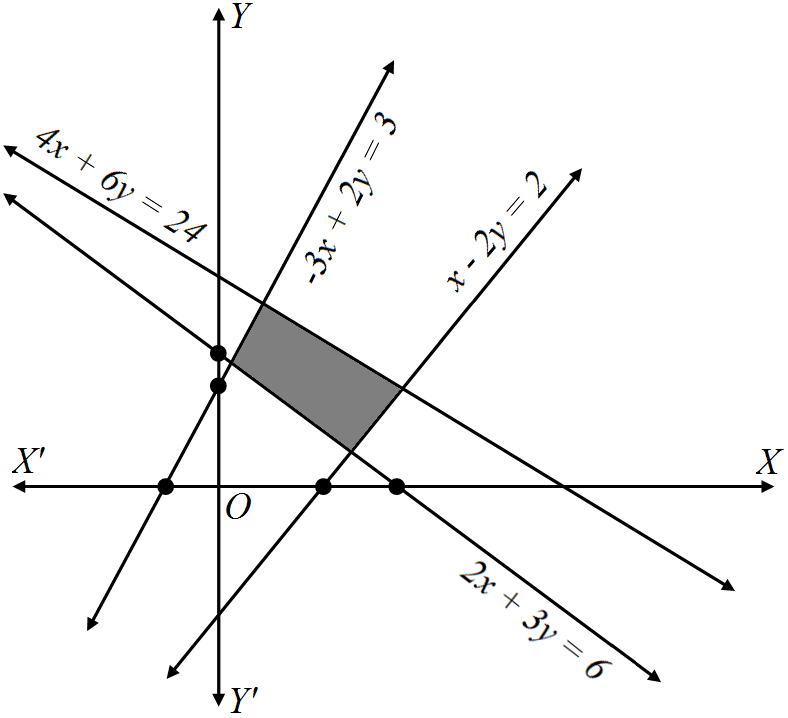
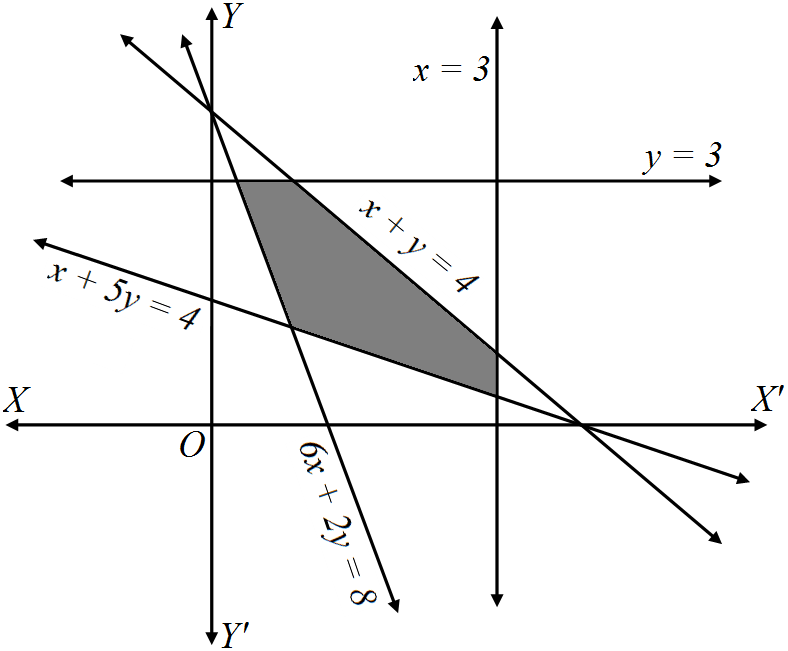
Find the linear inequations for which the shaded area in Fig. is the solution set. Draw the diagram of the solution set of the linear inequations:

Evaluate the following limit:
$\lim\limits_{\text{x}\rightarrow3}\frac{\text{x}^{\text{n}}-3^\text{n}}{\text{x}-\text{3}}=108,$ find the value of n.
If $\text{m}\sin\theta=\text{n}\sin(\theta+2\alpha),$ then prove that $\tan(\theta+\alpha)\cot\alpha=\frac{\text{m}+\text{n}}{\text{m}-\text{n}}$

[Hint: Express $\frac{\sin(\theta+2\alpha)}{\sin\theta}=\frac{\text{m}}{\text{n}}$ and apply componendo and dividendo]