Question
Prove that:
$\sin105^\circ+\cos105^\circ=\cos45^\circ$

Answer

$\text{LHS}=\sin105^\circ+\cos105^\circ$
$\sin105^\circ+\cos(90^\circ+15^\circ)$
$\sin105^\circ-\sin15^\circ$
$=\ 2\sin\Big(\frac{105^\circ-15^\circ}{2}\Big)\cos\Big(\frac{105^\circ+15^\circ}{2}\Big)$
$=\ 2\sin45^\circ\cos60^\circ$
$=\ 2\frac{1}{\sqrt2}\frac{1}{2}$
$=\ \frac{1}{\sqrt2}$
$=\ \cos45^\circ$

Need a full question paper?

Generate a complete, print-ready paper with questions like this in minutes — across 16+ boards, with answer keys.

Start Generating Free

Similar questions

The line through the points (h, 3) and (4, 1) intersects the line 7x - 9y - 19 = 0 at right angle. Find the value of h.
 x at x = 1
Find a point on the x-axis, which is equidistant from the points (7, 6) and (3, 4).
Find the angle in radian through which a pendulum swings, if its length is 75 cm and tip describes an arc of length 21 cm.
Three coins are tossed Describe.

Two events A and B which are not mutually exclusive.
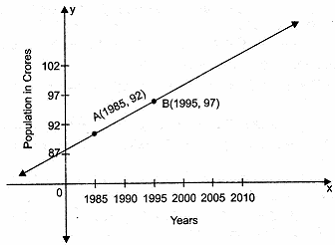
Consider the following population and year graph, find the slope of the line AB and using it, find what will be the population in the year 2010?

Find the derivative of function $\frac{{p{x^2} + qx + r}}{{ax + b}}$ (it is to be understood that a, b, c, d, p, q, r and s are fixed non-zero constants and m and n are integers).
Express the following complex numbers in the standard form a + ib:
$\Big(\frac{1}{1-4\text{i}}-\frac{2}{1+\text{i}}\Big)\Big(\frac{3-4\text{i}}{5+\text{i}}\Big)$
The numbers 1, 2, 3 and 4 are written separately on four slips of paper. The slips are then put in a box and mixed thoroughly. A person draws two slips from the box, one after the other, without replacement.
Describe the following events:
 A = The number on the first slip is larger than the one on the second slip.
B = The number on the second slip is greater than 2.
C = The sum of the numbers on the two slips is 6 or 7.
D = The number on the second slips is twice that on the first slip.
Which pair(s) of events is (are) mutually exclusive?
 Express $(-\sqrt3 + \sqrt{-2})(2\sqrt3 - i)$ in the form of a + ib.