Question
Prove that:
$\sin(70^\circ+\theta)-\cos(20^\circ-\theta)=0$

Answer

$\text{L.H.S.}=\sin(70^\circ+\theta)-\cos(20^\circ-\theta)$
$=\sin\big\{90^\circ-(20^\circ-\theta)\big\}-\cos(20^\circ-\theta)$
$=\cos(20^\circ-\theta)-\cos(20^\circ-\theta)$
$=0$
$=\text{R.H.S.}$

Need a full question paper?

Generate a complete, print-ready paper with questions like this in minutes — across 16+ boards, with answer keys.
Start Generating Free

Similar questions

A vertically straight tree, 15m high, is broken by the wind in such a way that it top just touches the ground and makes an angle of 60° with the ground. At what height from the ground did the tree break?
A play ground has the shape of a rectangle, with two semi-circles on its smaller sides as diameters, added to its outside. If the sides of the rectangle are 36m and $24.5\ m$, find the area of the playground. $\Big(\text{Take }\pi=\frac{22}{7}\Big).$
Find the points of trisection of the line segment joining the points:
(5, -6) and (-7, 5).
If the HCF of 657 and 963 is expressible in the form 657x + 963x - 15, find x.
Cards with numbers $2$ to $101$ are placed in a box. A card is selected at random. Find the probability that the card has:
  1. An even number.
  2. A square number.
The sum of the first 7 term of an AP is 49 and the sum of its first 17 terms is 289. Find the sum of its first n terms.
A positive integer is of the form $3q + 1$, q being a natural number. Can you write its square in any form other than $3m + 1, 3m$ or $3m + 2$ for some integer m? Justify your answer.
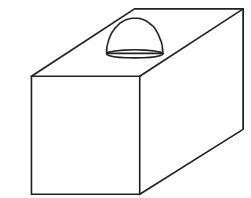
In the figure below, a decorative block, made up of two solids $-$ a cube and a hemi $-$ sphere? The base of the block is a cube of side $6 \ cm$ and the hemisphere fixed on the top has a diameter of $3.5 \ cm$ . Find the total surface area of the block. $\text { (use } \left.\pi=\frac{22}{7}\right)$
Image
Prove the following trigonometric identities.
If $\cos\text{A}+\cos^2\text{A}=1,$ prove that $\sin^2\text{A}+\sin^4\text{A}=1.$
Prove that $\frac{{\sin \theta - \cos \theta + 1}}{{\sin \theta + \cos \theta - 1}} = \frac{1}{{\sec \theta - \tan \theta }}$, using identity $sec^2\theta=1+tan^2\theta$.