Question
Prove that $(\sqrt{2}+\sqrt{3})$ is irrational.

Answer

self

Need a full question paper?

Generate a complete, print-ready paper with questions like this in minutes — across 16+ boards, with answer keys.
Start Generating Free

Similar questions

In a parallelogram $\text{ABCD}, E$ and $F$ are the midpoints of the sides $AB$ and $CD$ respectively. The line segments $AF$ and $BF$ meet the line segments $DE$ and $CE$ at points $G$ and $H$ respectively Prove that$: \triangle GEA \cong \triangle GFD$
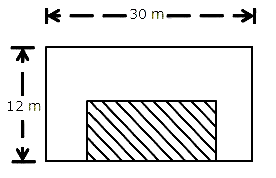
The shaded region of the given diagram represents the lawn in the form of a house. On the three sides of the lawn, there are flowerbeds having a uniform width of $2 m.$

$(i)$ Find the length and the breadth of the lawn.
$(ii)$ Hence, or otherwise, find the area of the flower$-$beds.
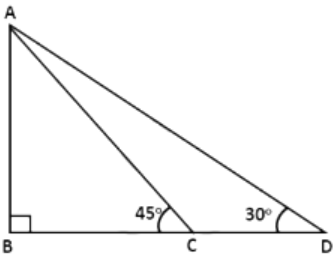
In the given figure; $\angle B = 90^\circ , \angle ADB = 30^\circ , \angle ACB = 45^\circ $ and $AB = 24\ m.$ Find the length of $CD.$
Image
The circumference of a circle is 123.2 cm.
Calculate:
(i) the radius of the circle in cm;
(ii) the area of the circle to the nearest $cm ^2$
(iii) the effect on the area of the circle if the radius is doubled..
Prove that the angle subtended at the centre of a circle, is bisected by the radius passing through the mid-point of the arc.
$P$ is any point inside the $\triangle ABC.$Prove that$: \angle BPC > \angle BAC.$
Find the radius and area of the circle which has circumference equal to the sum of circumferences of the two circles of radii $3 \ cm$ and $4 \ cm$ respectively.
If $\left(a^2+b^2+c^2\right)=89$ and $(a b-b c-c a)=16$, find the value of $(a+b-c)$.
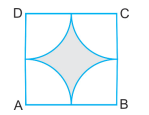
In the given figure, ABCD is a square of side 14 cm and A, B, C, D are centres of circular arcs, each of radius 7 cm. Find the area of the shaded region.
Image
The sum of the numerator and denominator of a fraction is $12$ . If the denominator is increased by $3 ,$ the fraction becomes $\frac{1}{2}$. Find the fraction.