Question
Prove that $\sqrt{\frac{1+\cos A}{1}}=\operatorname{cosec} A+\cot A$

Answer

$ \text { L.H.S }=\sqrt{\frac{1+\cos A}{1-\cos A}}$
$ =\sqrt{\frac{1+\cos A}{1-\cos A} \times \frac{1+\cos A}{1+\cos A}} \ldots \ldots [ $On rationalising the denominator$]$
$ =\sqrt{\frac{(1+\cos A)^2}{1-\cos ^2 A}}$
$=\sqrt{\frac{(1+\cos A)^2}{\sin ^2 A}} \quad \ldots \ldots\left[\begin{array}{l}\because \sin ^2 A+\cos ^2 A=1 \\ \therefore 1-\cos ^2 A=\sin ^2 A\end{array}\right]$
$ =\frac{1+\cos A}{\sin A}$
$ =\frac{1}{\sin A}+\frac{\cos A}{\sin A}$
$ =\operatorname{cosec} A+\cot A$
$ =\text { R.H.S }$
$ \therefore \sqrt{\frac{1+\cos A}{1-\cos A}}=\operatorname{cosec} A+\cot A$

Need a full question paper?

Generate a complete, print-ready paper with questions like this in minutes — across 16+ boards, with answer keys.
Start Generating Free

Similar questions

The perimeters of two similar triangles are 25cm and 15cm respectively. If one side of first triangle is 9cm, what is the corresponding side of the other triangle?
The sixth term of an A.P. is 5 times the $1^{\text {st }}$ term and the eleventh term exceeds twice the fifth term by 3. Find the $8^{\text {th }}$ term.
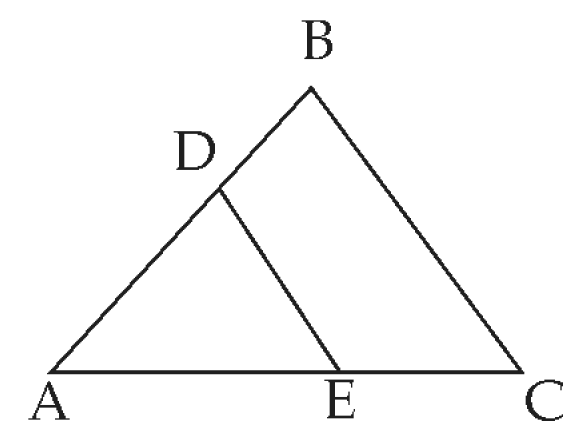
In the adjoining figure, seg DE || side BC. If DE: BC=3:5, then find $A (\triangle ADE ): A (\triangle DBCE )$  
Image
If $\sin A=\frac{3}{5}$ then show that $4 \tan A+3 \sin A=6 \cos A$
Mrs. Sita invested ₹ 92,124 in shares of face value ₹ 10 each at ₹ 90 market value. She paid 2 % brokerage and 18 % GST on it. Company declared a dividend of 60 % on then. Find her dividend.
If $\cos\theta=\frac{4}{5},$ find all other trigonometric rations of angle $\theta$.
Market value of shares and dividend declared by the two companies is given below. Face Value is same and it is Rs. 100 for both the shares. Investment in which company is more profitable?
(1) Company A - Rs. 132 , 12%
(2) Company B - Rs. 144, 16%
A conical flask is full of water. The flask has base-radius r and height h. The water is poured into a cylindrical flask of base-radius mr. Find the height of water in the cylindrical flask.
  1. A lot of 20 bulbs contain 4 defective ones. One bulb is drawn at random from the lot. What is the probability that this bulb is defective?
  2. Suppose the bulb drawn in (i) is not defective and not replaced. Now bulb is drawn at random from the rest. What is the probability that this bulb is not defective?