Question
Prove that the bisectors of two adjacent supplementary angles include a right angle.
Answer

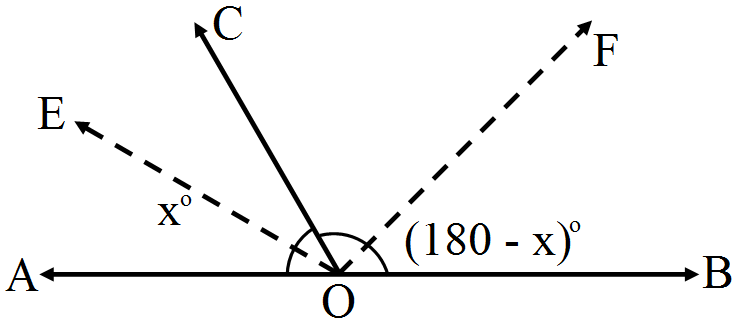
Let AOB denote a straight line and let$\angle\text{AOC}$ and $\angle\text{BOC}$
be the supplementary angles. Then, we have:$\angle\text{AOE}=\angle\text{COE}=\frac{1}{2}\text{x}^\circ\text{ and}$
$\angle\text{BOF}=\angle\text{FOC}=\frac{1}{2}(180-\text{x})^\circ$
Therefore,$\angle\text{COE}+\angle\text{FOC}=\frac{1}{2}\text{x}+\frac{1}{2}(180^\circ-\text{x})$
$=\frac{1}{2}(\text{x}+180^\circ-\text{x})$
$=\frac{1}{2}(180^\circ)$
$=90^\circ$

Need a full question paper?

Generate a complete, print-ready paper with questions like this in minutes — across 16+ boards, with answer keys.

Start Generating Free

Similar questions

The following data gives the production of food grains (In thousand tonnes) for some years:
Year
1995
1996
1997
1998
19999
2000
Production (in thousand tonnes)
120
150
140
180
170
190
Represent the above data with the help of a bar graph.
If the median of $33,28,20,25,34$, $x$ is 29 , find the maximum possible value of $x$.
A triangle and a parallelogram have the same base and the same area. If the sides of the triangle are $13 cm, 14 cm$ and 15 cm and the parallelogram stands on the base 14 cm , find the height of a parallelogram.
Calculate the area of trapezium PQRS, given in figure (ii).

Diagonals of a rhombus are $20\ cm$ and $21\ cm$ respectively, then find the side of rhombus and its Perimeter.
If $a+b+c=9$ and $a b+b c+c a=26$, find value of $a^3+b^3+c^3-3 a b c$.
A soft drink is available in two packs-
(i) a tin can with a rectangular base of length 5cm and width 4cm, having a height of 15cm and
(ii) a plastic cylinder with circular base of diameter 7cm and height 10cm, Which container has greater capacity and by how much?
It being given that $\sqrt{3}=1.732,\sqrt{5}=2.236,\sqrt{6}=2.449$ and $\sqrt{10}=3.162,$ find to three places of decimal, the value of the following:$\frac{3+\sqrt{5}}{3-\sqrt{5}}$
In the adjoining figure, ABCD is a trapezium in which AB || DC; AB = 7cm; AD = BC = 5cm and the distance between AB and DC is 4cm. Find the length of DC and hence, find the area of trap. ABCD.
Prove that each angle of an equilateral triangle is 60°.