Question
Prove that the center of mass of a hemispherical body is at a height of $\frac{3 R}{8}$ at the base.

Answer

self

Need a full question paper?

Generate a complete, print-ready paper with questions like this in minutes — across 16+ boards, with answer keys.
Start Generating Free

Similar questions

Define moment of inertia of a body. Give its units and dimensions. What is the physical significance of moment of inertia?
A drop of water, $2 mm$ in diameter, falling from a height of $50 cm$ in a bucket generates sound which can be heard from the $5 m$ distance. Take all the gravitational energy difference as going into the sound form, the transformation being spread in time over $0.2 s$ . Deduce the average intensity and the amplitude of vibration at the listener's end. Given: density of air $=1.3 \mathrm{~kg} \mathrm{~m}^{-3}$, frequency of wave $=1000 \mathrm{~Hz}$ and $\mathrm{c}=350 \mathrm{~ms}^{-1}$ ?
Mercury has an angle of contact equal to $140°$ with soda lime glass. A narrow tube of radius $1.00mm$ made of this glass is dipped in a trough containing mercury. By what amount does the mercury dip down in the tube relative to the liquid surface outside? Surface tension of mercury at the temperature of the experiment is $0.465N m^{-1}$. Density of mercury = $13.6 \times 10^3kg m^{-3}$.
In Millikan's oil drop experiment, what is the terminal speed of an uncharged drop of radius $2.0 \times 10^{-5} \mathrm{~m}$ and density $1.2 \times 10^3 \mathrm{~kg} \mathrm{~m}^{-3}$. Take the viscosity of air at the temperature of the experiment to be $1.8 \times 10^{-5} \mathrm{Pas}$. How much is the viscous force on the drop at that speed? Neglect buoyancy of the drop due to air.
The resistance of an iron wire and a copper wire at 20°C are $3.9\Omega$ and $4.1\Omega,$ respectively. At what temperature will the resistance be equal? Temperature coefficient of resistivity for iron is $5.0\times10^{-3}\text{K}^{-1}$ and for copper, it is $4.0\times10^{-3}\text{K}^{-1}.$ Neglect any thermal expansion.
You are riding in an automobile of mass 3000 kg . Assuming that you are examining the oscillation characteristics of its suspension system. The suspension sags 15 cm when the entire automobile is placed on it. Also, the amplitude of oscillation decreases by $50 \%$ during one complete oscillation. Estimate the values of
a. the spring constant $k$ and
b. the damping constant b for the spring and shock absorber system of one wheel, assuming that each wheel supports 750 kg .
Three vessels of equal capacity have gases at the same temperature and pressure. The first vessel contains neon (monatomic), the second contains chlorine (diatomic), and the third contains uranium hexafluoride (polyatomic). Do the vessels contain equal number of respective molecules? Is the root mean square speed of molecules the same in the three cases? If not, in which case is vrms the largest?
A truck starts from rest and accelerates uniformly at $2.0ms^{-2}$. At $t = 10s$, a stone is dropped by a person standing on the top of the truck ($6m$ high from the ground). What are the (a) velocity, and (b) acceleration of the stone at $t = 11s$? (Neglect air resistance.)
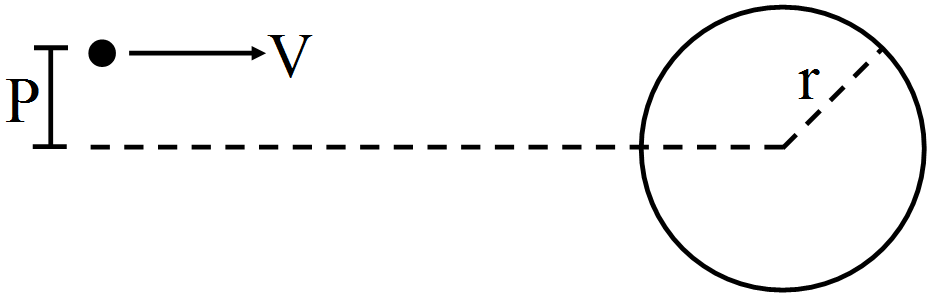
A small particle travelling with a velocity u collides elastically with a spherical body of equal mass and of radius r initially kept at rest. The centre of this spherical body is located a distance (p < r) away from the direction of motion of the particle. Find the final velocities of the two particles. [Hint: The force acts along the normal to the sphere through the contact. Treat the collision as onedimensional for this direction. In the tangential direction no force acts and the velocities do not change].
An electron of kinetic energy 100eV circulates in a path of radius 10cm in a magnetic field. Find the magnetic field and the number of revolutions per second made by the electron.