Question
Prove that the centre of a circle touching two intersecting lines lies on the angle bisector of the lines.
Answer

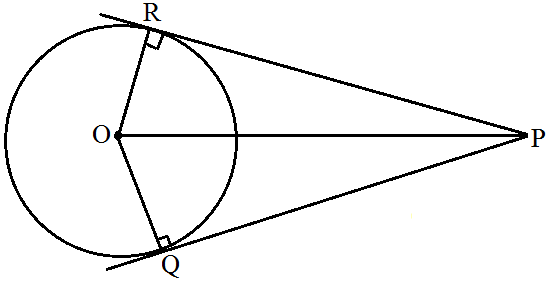
Given two tangents PQ and PR are drawn from an external point P to a circle with centre O.
To prove centre of a circle touching two intersecting lines lies on the angle bisector of the lines. In $\angle\text{RPQ}.$ Construction Join OR, and OQ. In $\triangle\text{POP and }\triangle\text{POO}$ $\angle\text{PRO}\cong\angle\text{PQO}=90^\circ$ [tangent at any point of a circle is perpendicular to the radius through the point of contact] OR = OQ [radii of some circle] Since OP is common $\therefore\ \triangle\text{PRO}\cong\triangle\text{PQO}$ [RHS] Hence, $\angle\text{RPO}=\angle\text{QPO}$ [by CPCT] Thus, O lies on angle bisecter of PR and PQ. Hence proved.

Need a full question paper?

Generate a complete, print-ready paper with questions like this in minutes — across 16+ boards, with answer keys.
Start Generating Free

Similar questions

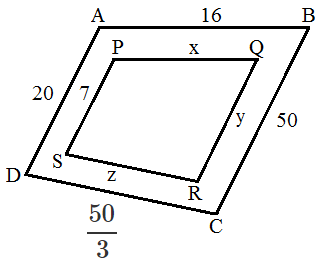
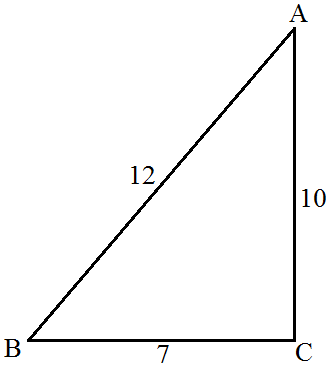
In the given figure, given that $\triangle\text{ABC}\sim\triangle\text{PQR}$ and quad ABCD ∼ quad PQRS. Determine the value of x, y, z in each case.
  1.  
  1.  
  1.  
A solid is in the shape of a right$-$circular cone surmounted on a hemisphere, the radius of each of them being $7 \ cm$ and the height of the cone is equal to its diameter. Find the volume of the solid.
If $(\cot\theta+\tan\theta)=\text{m}$ and $(\sec\theta-\cos\theta)=\text{n},$ prove that $\big(\text{m}^2\text{n}\big)^\frac23-\big(\text{m}\text{n}^2\big)^\frac23=1.$
A cylindrical tube of radius 12cm contains water to a depth of 20cm. A spherical ball dropped into the tub and the level of the water is raised by 6.75cm. Find the radius of the ball.
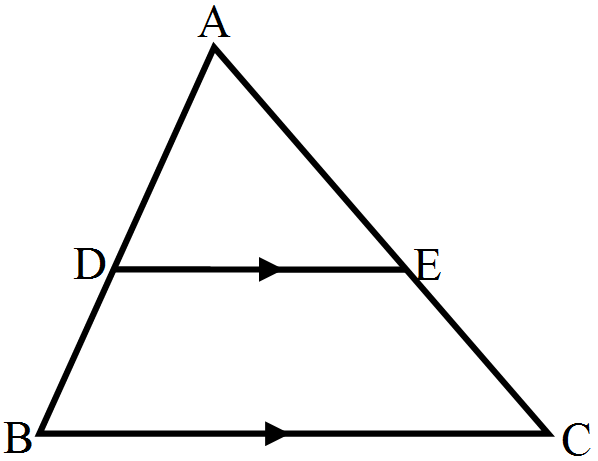
D and E are points on the sides AB and AC respectively of a $\triangle\text{ABC}$ such that DE || BC:
If $\frac{\text{AD}}{\text{DB}}=\frac{4}{7}$ and AC = 6.6cm, find AE.
The sum of squares of two consecutive multiples of 7 is 637. Find the multiples.

Find the 20th term from the last term of the AP : 3, 8, 13, …., 253.

A fraction becomes $\frac { 9 } { 11 }$ if 2 is added to both numerator and denominator. If 3 is added to both numerator and denominator it becomes $ \frac { 5 } { 6 }$. Find the fraction by substitution method.
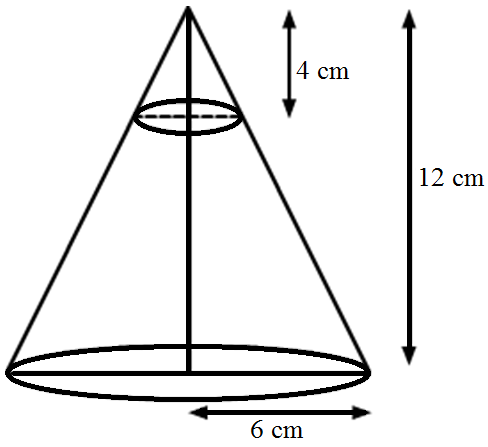
In the given figure, from the top of a solid cone of height 12cm and base radius 6cm, a cone of height 4cm is removed by a plane parallel to the base. Find the total surface area of the remaining solid.$\Big(\text{use}\ \pi=\frac{22}{7}\text{and}\sqrt{5}=2.236\Big).$
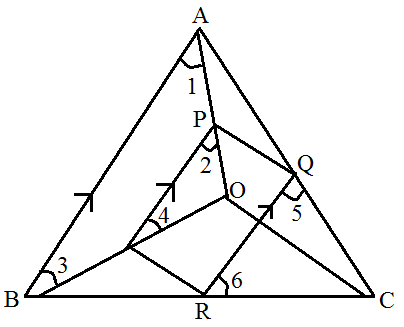
If PQRS is a parallelogram and AB || PS, then prove that OC || SR.