Question
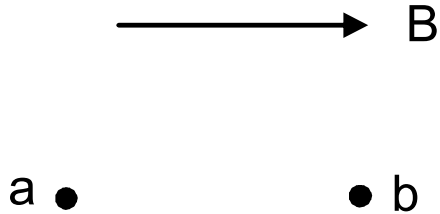
Prove that the force acting on a current-carrying wire, joining two fixed points a and b in a uniform magnetic field, is independent of the shape of the wire.
Answer


For force on a current carrying wire in an uniform magnetic field
We need, l → length of wire
i → Current
B → Magnitude of magnetic field
Since $\overrightarrow{\text{F}}=\text{i}\ell\text{B}$
Now, since the length of the wire is fixed from A to B, so force is independent of the shape of the wire.

Need a full question paper?

Generate a complete, print-ready paper with questions like this in minutes — across 16+ boards, with answer keys.

Start Generating Free

Similar questions

A $0.5m$ long metal rod $PQ$ completes the circuit as shown in the figure. The area of the circuit is perpendicular to the magnetic field of flux density $0.15T.$ If the resistance of the total circuit is $3\Omega$ calculate the force needed to move the rod in the direction as indicated with a constant speed of $2\ ms^{-1}.$
Give a circuit diagram of a common emitter amplifier using an n-p-n transistor. Draw the input and output waveforms of the signal. Write the expression for its voltage gain.
A beam of light converges at a point P. Now a lens is placed in the path of the convergent beam 12cm from P. At what point does the beam converge if the lens is (a) a convex lens of focal length 20cm, and (b) a concave lens of focal length 16cm?
The horizontal component of the earth's magnetic field at a certain place is $3.0 \times 10^{-5} T$ and the direction of the field is from the geographic south to the geographic north. A very long straight conductor is carrying a steady current of $1 A$. What is the force per unit length on it when it is placed on a horizontal table and the direction of the current is $(a)$ east to west; $(b)$ south to north?
A concrete slab has a length of $10m$ on a winter night when the temperature is $0^\circ C.$ Find the length of the slab on a summer day when the temperature is $35­^\circ C.$ The coefficient of linear expansion of concrete is $1.0 \times 10^-5­^\circ C^{-1}$
Two narrow slits emitting iight in phase are separated by a distance of $1.0\ cm$. The wavelength of the light is $5.0 \times 10^{-7}m.$ The interference pattern is observed on a screen placed at a distance of $1.0m.$
  1. Find the separation between the consecutive maxima. Can you expect to distinguish between these maxima?
  2. Find the separation between the sources which will give a separation of $1.0\ mm$ between the consecutive maxima.
Double $-$ convex lenses are to be manufactured from a glass of refractive index $1.55,$ with both faces of the same radius of curvature. What is the radius of curvature required if the focal length is to be $20\ cm$?
A $p-n$ photodiode is fabricated from a semiconductor with band gap of $2.8\ eV$. Can it detect a wavelength of $6000\ nm$?
A mobile phone is placed on the principal axis of a concave mirror. Show the formation of the image with a suitable ray diagram. Explain why the magnification is not uniform. Does the distortion of the image depend on the position of the phone relative to the mirror?
A wheel rotating at a speed of $600\ rpm ($revolutions per minute$)$ about its axis is brought to rest by applying a constant torque for $10$ seconds. Find the angular deceleration and the angular velocity $5$ seconds after the application of the torque.