Question
Prove that the function $f : R → R$ defined by $f (x) = 2x + 5$ is one-one.

Answer

Note that a function $f$ is one-one if
$f(x_1 ) = f (x_2 )\Rightarrow x_1 = x_2 ($definition of one-one function$)$
Now, given that $f (x_1 ) = f (x_2 ), i.e., 2x_1 + 5 = 2x_2 + 5$
$\Rightarrow 2x_1 + 5 – 5 = 2x_2 + 5 – 5 ($adding the same quantity on both sides$)$
$2x_1 + 0 = 2x_2 + 0$
$2x_1 = 2x_2( $using additive identity of real number$)$
$\frac{2}{2} x_{1}=\frac{2}{2} x_{2}$ dividing by the same non zero quantity
$x_1 = x_2$ 
Hence, the given function is one one

Need a full question paper?

Generate a complete, print-ready paper with questions like this in minutes — across 16+ boards, with answer keys.
Start Generating Free

Similar questions

Find the equation of the normal lines to the curve $3x^2 - y^2 = 8$ which are parallel to the line $x + 3y = 4.$
If $\text{y}^\text{x}=\text{e}^{\text{x}-\text{e}},$ prove that $\frac{\text{dy}}{\text{dx}}=\frac{(1+\log\text{y})^2}{\log\text{y}}$
Solve the matrix equations:
$\begin{bmatrix}1&2&1\end{bmatrix}\begin{bmatrix}1&2&0\\2&0&1\\1&0&2\end{bmatrix}\begin{bmatrix}0\\2\\\text{x}\end{bmatrix}=0$
Find the shortest distance between the following pairs of parallel lines whose equations are:$\vec{\text{r}}=\big(\hat{\text{i}}+2\hat{\text{j}}+3\hat{\text{k}}\big)+\lambda\big(\hat{\text{i}}-\hat{\text{j}}+\hat{\text{k}}\big)$ and $\vec{\text{r}}=\big(2\hat{\text{i}}-\hat{\text{j}}-\hat{\text{k}}\big)+\mu\big(-\hat{\text{i}}+\hat{\text{j}}-\hat{\text{k}}\big)$
Evaluate the following integrals:
$\int\limits_{0}^{\pi}\frac{1}{3+2\sin\text{x}+\cos\text{x}}\text{ dx}$
Solve the matrix equations:
$\begin{bmatrix}2\text{x}&3\end{bmatrix}\begin{bmatrix}1&2\\-3&0\end{bmatrix}\begin{bmatrix}\text{x}\\8\end{bmatrix}=0$
Solve the following systems of linear equations by cramer's rule:
5x - 7y + z = 11,
6x - 8y - z = 15,
3x + 2y - 6z = 7
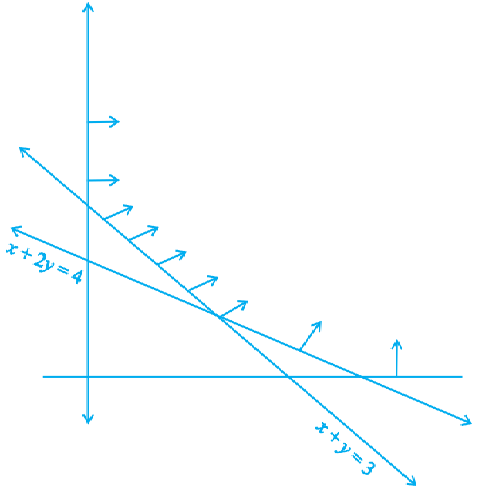
The feasible region for a LPP is shown in Evaluate Z = 4x + y at each of the corner points of this region. Find the minimum value of Z, if it exists.
Determine two positive numbers whose sum is $15$ and the sum of whose squares is maximum.
Find the shortest distance between the following pairs of lines whose vector equations are:
$\vec{\text{r}}=(1-\text{t})\hat{\text{i}}+(\text{t}-2)\hat{\text{j}}+(3-\text{t})\hat{\text{k}}$ and $\vec{\text{r}}=(\text{s}+1)\hat{\text{i}}+(2\text{s}-1)\hat{\text{j}}-(2\text{s}+1)\hat{\text{k}}$