Question
Prove that the given vectors are non-coplanar:
$\hat{\text{i}}+2\hat{\text{j}}+3\hat{\text{k}},\ 2\hat{\text{i}}+\hat{\text{j}}+3\hat{\text{k}}$ and $\hat{\text{i}}+\hat{\text{j}}+\hat{\text{k}}$
Answer

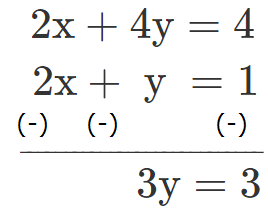
We know that, Three vectors are coplanar if any one of them vector can be expressed as the linear combination of the other two. Let, $\hat{\text{i}}+2\hat{\text{j}}+3\hat{\text{k}}\\=\text{x}\big(2\hat{\text{i}}+\hat{\text{j}}+3\hat{\text{k}}\big)+\text{y}\big(\hat{\text{i}}+\hat{\text{j}}+\hat{\text{k}}\big)$ $=2\text{x}\hat{\text{i}}+\text{x}\hat{\text{j}}+3\text{x}\hat{\text{k}}+\text{y}\hat{\text{i}}+\text{y}\hat{\text{j}}+\text{y}\hat{\text{k}}$ $\therefore\ \hat{\text{i}}+2\hat{\text{j}}+3\hat{\text{k}}\big)\\=\big(2\text{x}+\text{y}\big)\hat{\text{i}}+\big(\text{x}+2\text{y}\big)\hat{\text{j}}+\big(3\text{x}+\text{y}\big)\hat{\text{k}}$ comparing the coefficient of LHS and RHS, 2x + y = 1 .....(i) x + 2y = 2 .....(ii) 3x + y = 3 .....(iii) subtracting 2 × (ii) from equation (i),
$\text{y}=\frac{3}3$ $\text{y}=1$ Put the value of y in equation (i), $2\text{x}+\text{y}=1$ $2\text{x}+1=1$ $2\text{x}=1-1$ $2\text{x}=0$ $\text{x}=\frac{0}2$ $\text{x}=0$ Put the value of x and y in equation (iii), $3\text{x}+\text{y}=3$ $3(0)+1=3$ $0+1=3$ $1=3$ $\text{LHS}\neq\text{RHS}$ The value of x and y do not satisfy the equation (iii), Hence, vectors are non-coplanar.

Need a full question paper?

Generate a complete, print-ready paper with questions like this in minutes — across 16+ boards, with answer keys.

Start Generating Free

Similar questions

Evaluate the following integrals:
$\int_{\frac{\pi}{6}}^\limits{\frac{\pi}{3}}(\tan\text{x}+\cot\text{x})^2\text{dx}$
Differentiate the following functions with respect to x:
$\sin(2\sin^{-1}\text{x})$
Evaluate the following integrals:
$\int(2\text{x}+3)\sqrt{\text{x}^2+4\text{x}+3}\text{dx}$
A relation R is defined from {2, 3, 4, 5} to {3, 6, 7, 10} by : xRy ⇔ x is relatively prime to y. Then, domain of R is:
  1. {2, 3, 5}
  2. {3, 5}
  3. {2, 3, 4}
  4. {2, 3, 4, 5}
A bag contains 25 tickets, numbered from 1 to 25. A ticket is drawn and then another ticket is drawn without replacement. Find the probability that both tickets will show even numbers.
If $\text{y}=\sin^{-1}\Big(\frac{\text{x}}{1+\text{x}^2}\Big)+\cos^{-1}\Big(\frac{1}{\sqrt{1+\text{x}^2}}\Big), 0<\text{x}<\infty$ prove that $\frac{\text{dy}}{\text{dx}}=\frac{4}{1+\text{x}^2}$
Evaluate the following integrals:
$\int\frac{\text{e}^{\text{3x}}}{4\text{e}^{6\text{x}}-9}\text{dx}$
Find the angle between the following pairs of lines:$\frac{\text{x}-2}{3}=\frac{\text{y}+3}{-2},\text{z}=5$ and $\frac{\text{x}+1}{1}=\frac{2\text{y}-3}{3}=\frac{\text{z}-5}{2}$
The resultant of two forces $\vec{\text{P}}$ and $\vec{\text{Q}}$ acting at an angle $\theta$is equal to $(2m+1)\sqrt{P^{2}+Q^{2}}$ and when they act at a angle $\Bigg(\frac{\pi}{2}-\theta\Bigg)$the resultant is equal to $(2m-1)\sqrt{P^{2}+Q^{2}}$. Show that $\tan\theta=\frac{m-1}{m+1}.$
Show that the differential equation of $(x-y) d y-(x+y) d x=0$ is homogeneous and solve it.