Question
Prove that the maximum horizontal range is four times the maximum height attained by a projectile which is fired along the required oblique direction.

Answer

The required angle of projection for max. horizontal range is 45°. $\text{R}_\text{max}=\frac{\text{u}^2}{\text{g}}$ Max. height, $\text{H}=\frac{\text{u}^2\sin^2\theta}{2\text{g}}$ $=\frac{\text{u}^2\sin^245^\circ}{2\text{g}}=\frac{\text{u}^2}{4\text{g}}$ $\frac{\text{R}_\text{max}}{\text{H}}=\frac{\frac{\text{u}^2}{\text{g}}}{\frac{\text{u}^2}{4\text{g}}}=4$ or $\text{R}_\text{max}=4\text{H}$

Need a full question paper?

Generate a complete, print-ready paper with questions like this in minutes — across 16+ boards, with answer keys.
Start Generating Free

Similar questions

Calculate the dimensions of:
  1. $\int\vec{\text{E}}.\vec{\text{dl}}.$
  2. $\text{vBl}$
  3. $\frac{\text{d}\psi_{\text{B}}}{\text{dt}}$
The symbols have their usual meanings.
A Kundt's tube apparatus has a steel rod of length 1.0m clamped at the centre. It is vibrated in its fundamental mode at a frequency of 2600Hz. The lycopodium powder dispersed in the tube collects into heaps separated by 6.5cm. Calculate the speed of sound in steel and in air.
The metre is defined as the distance travelled by light in $\frac{1}{299,792,458}$ second. Why didn't people choose some 1 easier number such as $\frac{1}{300,000,000}$ second? Why not 1 second?
$12J$ of work has to be done against an existing electric field to take a charge of $0.01C$ from A to B. How much is the potential difference $V_B - V_A$?
Temperature in the freezer of a refrigerator is being maintained at $-13^\circ C$ and room temperature on a particular day was $42^\circ C$. Calculate the coefficient of performance of the refrigerator.
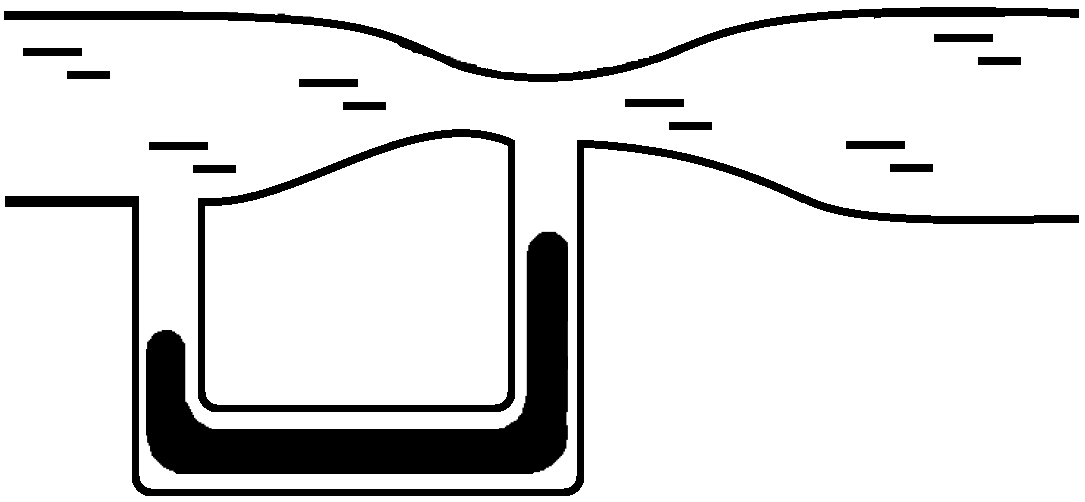
Water flows through the tube shown in The areas of cross-section of the wide and the narrow portions of the tube are $5 \mathrm{~cm}^2$ and $2 \mathrm{~cm}^2$ respectively. The rate of flow of water through the tube is $500 \mathrm{~cm}^3 / \mathrm{s}$. Find the difference of mercury levels in the U-tube.
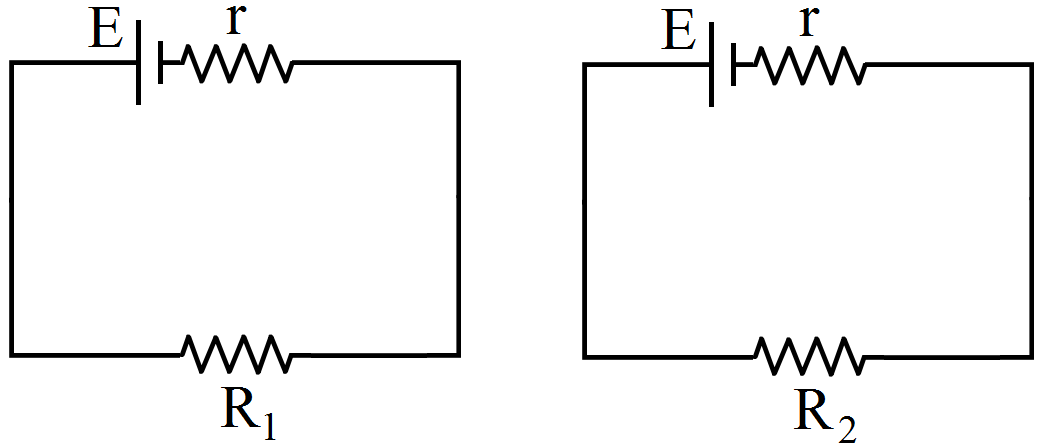
Two unequal resistances $R_1$ and $R_2$ are connected across two identical batteries of emf $\varepsilon$ and internal resistance r. Can the thermal energies developed in $R_1$ and $R_2$ be equal in a given time. If yes, what will be the condition?
State Bernoulli's Theorem.
Why do we need Quantum theory?