Question
Prove that the path of a projectile is a parabola.

Answer

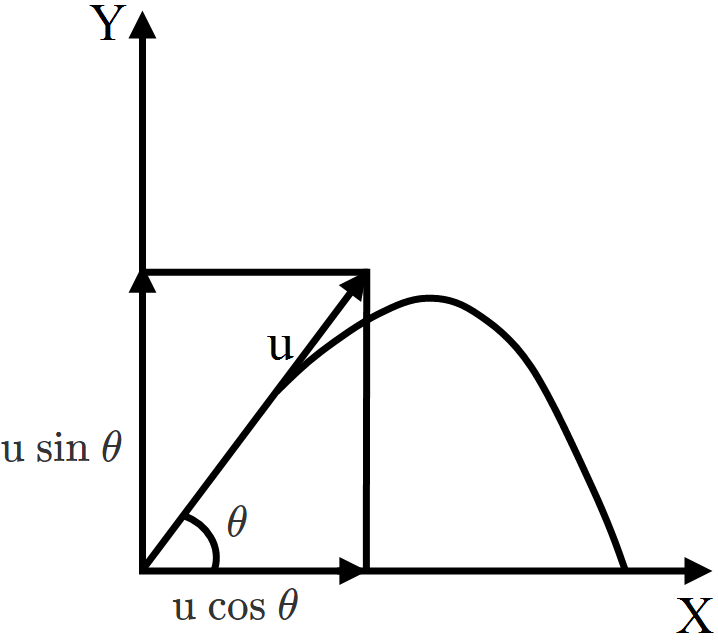
Consider a projectile thrown at an angle $\theta$ with a velocity u. The components of velocity horizontal and vertical are $\text{u}\cos\theta$ and $\text{u}\sin\theta.$ After time t, the horizontal displacement $\text{x}=\text{u}\cos\theta\text{t}$
The vertical displacement, $\text{y}=\text{u}\sin\theta\text{ t}-\frac{1}{2}\text{gt}^2$ $\therefore\ \text{y}=\text{u}\sin\theta.\Big(\frac{\text{x}}{\text{u}\cos\theta}\Big)-\frac{1}{2}\text{g}\Big(\frac{\text{x}}{\text{u}\cos\theta}\Big)^2$ $\text{y}\propto\text{x}^2,$ the path of a projectile is a parabola.

Need a full question paper?

Generate a complete, print-ready paper with questions like this in minutes — across 16+ boards, with answer keys.
Start Generating Free

Similar questions

A body of mass 15 kg is hung by a spring balance in a lift. What would be the reading of the balance when
i. the lift is ascending with an acceleration of $2 ms^{-2}$
ii. descending with the same acceleration
iii. descending with a constant velocity of $2 ms^{-1}$ ?
Take $g =10 ms^{-2}$.
Establish a relation between angular momentum and moment of inertia of a rigid body. Define moment of inertia in terms of it.
What is the true weight of an object in a geostationary satellite that weighed exactly 10.0N at the north pole?
Show that range of projection of a projectile for two angles of a projection $\alpha$ and $\beta$ is same where $\alpha+\beta=90^\circ.$
Estimate the average mass density of a sodium atom assuming its size to be about $2.5 \mathring{\text{A}}.$ (Use the known values of Avogadro’s number and the atomic mass of sodium). Compare it with the mass density of sodium in its crystalline phase: $970kg m^{–3}. $Are the two densities of the same order of magnitude? If so, why?
The velocities of ten particles in $ms^{-1}$ are $0, 2, 3, 4, 4, 4, 5, 5, 6, 9.$ Calculate $(i)$ Average speed and $(ii) \text{r.m.s}.$ speed.
A thin prism of crown glass $(\mu_\text{r}=1.515,\mu_\text{v}=1.525)$ and a thin prism of flint glass $(\mu_\text{r}=1.612,\mu_\text{v}=1.632)$ are placed in contact with each other. Their refracting angles are 5.0° each and are similarly directed. Calculate the angular dispersion produced by the combination.
Two vessels have the same base area but different shapes. The first vessel takes twice the volume of water that the second vessel requires to fill upto a particular common height. Is the force exerted by the water on the base of the vessel the same in the two cases ? If so, why do the vessels filled with water to that same height give different readings on a weighing scale?
The photograph of a house occupies an area of $1.75cm^2$ on a $35mm$ slide. The slide is projected on to a screen, and the area of the house on the screen is $1.55m^2$. What is the linear magnification of the projector-screen arrangement.
Two stars each of one solar mass ($= 2 \times 10^{30}kg$) are approaching each other for a head on collision. When they are a distance $10^9km$, their speeds are negligible. What is the speed with which they collide? The radius of each star is $10^4km.$ Assume the stars to remain undistorted until they collide. (Use the known value of G).