Question
Prove that the points (2, 3), (-4, -6) and $\Big(1, \frac{3}{2}\Big)$ do not form a triangle.

Answer

Let the given points A(2, 3), B(-4, -6) and $\text{C}\Big(1, \frac{3}{2}\Big)$ Then, $\text{AB}=\sqrt{(-4-2)^2+(-6-3)^2}$ $=\sqrt{36+81}$ $=\sqrt{117}=\sqrt{9\times13}$ $=3\sqrt{13 }$ $\text{BC}=\sqrt{(1-(-4))^2+\Big(\frac{3}{2}-(-6)\Big)^2}$ $=\sqrt{25+\Big(\frac{3}{2}+6\Big)^2}$ $=\sqrt{25+\Big(\frac{15}{2}\Big)^2}$ $=\sqrt{25+\frac{225}{4}}$ $=\sqrt{\frac{100+225}{4}}$ $=\sqrt{\frac{335}{4}}$ $=\sqrt{83.75}$ $\text{AC}=\sqrt{(1-2)^2+\Big(\frac{3}{2}-3\Big)^2}$ $=\sqrt{1+\Big(\frac{3-6}{2}\Big)^2}$ $=\sqrt{1+\frac{9}{4}}=\sqrt{\frac{13}{4}}$$=\sqrt{3.25}$
We know that, In triangle sum of any two sides is greater than the third side. Since, $\text{AC} + \text{AB} \ngtr \text{BC}$Here, Sum of two sides is not greater than the third side.
Therefore, Points (2, 3), (-4, -6) and $\Big(1, \frac{3}{2}\Big)$ do not form a triangle.

Need a full question paper?

Generate a complete, print-ready paper with questions like this in minutes — across 16+ boards, with answer keys.
Start Generating Free

Similar questions

A courier company delivered a parcel from Mumbai to Pune. The customer paid ₹ 531 to the courier company. Now, tax invoice shows ₹ 450 as taxable price, CGST is ₹ 40.50 and SGST is ₹ 40.50 , then find the rate of GST applicable in this transaction.
Find a fraction which becomes $\Big(\frac{1}{2}\Big)$ when 1 is subtracted from the numerator and 2 is added to the denominator, and the fraction becomes $\Big(\frac{1}{3}\Big)$ when 7 is subtracted from the numerator and 2 is subtracted from the denominator.
A chord PQ of length 12cm subtends an angle of 120° at the centre of a circle. Find the area of the minor segment cut off by the chord PQ.
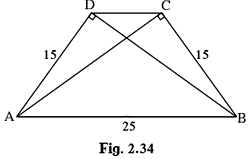
In a trapezium $A B C D$, seg $A B \| \operatorname{seg} D C$ seg $B D \perp \operatorname{seg} A D$, seg $A C \perp \operatorname{seg} B C$, If $A D=15, B C=15$ and $A B=25$. Find $A (\square ABCD )$
Solve: $2^x+3^y=17,2^{x+2}-3^{y+1}=5$
Solve the following system of equations by the method of cross-multiplication:
$(a - b)x + (a + b)y = 2a^2 - 2b^2$,
$(a + b)(x + y) = 4ab$.
A farmer borrows ₹ 1000 and agrees to repay with a total interest of ₹ 140 in 12 installments, each installment being less than the preceding installment by ₹ 10 . What should be his first installment?
The sum $4^{\text {th }}$ and $8^{\text {th }}$ terms of an A.P. is $24$ and the sum of $6^{\text {th }}$ and $10^{\text {th }}$ terms is $44$ . Find the A.P.?
A piggy bank contains hundred 50 paise coins, fifity ₹1 coins, twenty ₹2 coins and ten ₹5 coins. If it is equally likely that one of the coins will fall out when the bank is turned upside down, find the probability that the coin which fell:
  1. Will be a 50 paise coin.
  2. Will be of value more than ₹1.
  3. Will be of value less than ₹5.
  4. Will be a ₹1 or ₹2 coin.
Prove the following identities:
$\frac{\tan\theta}{\big(1+\tan^2\theta\big)}+\frac{\cot\theta}{\big(1+\cot^2\theta\big)}=\sin\theta\cos\theta$