Question
Prove that the product of three consecutive positive integer is divisible by 6.

Answer

Let, n be any positive integer. Since any positive is of the form 6q or 6q + 1 or, 6q + 2 or, 6q + 3 or 6q + 4 or 6q + 5.
If n - 6q, then
n(n + 1)(n + 2) = [(6q)(6q + 1)(6q + 2)]
= 6[q(6q + 1)(6q + 2)]
= 6m, which is divisible by 6
If n - 6q + 1, then
n(n + 1)(n + 2) = (6q + 1)(6q + 2)(6q + 3)
= 6[(6q + 1)(3q + 1)(2q + 1)]
= 6m, which is divisible by 6
If n - 6q + 2, then
n(n + 1)(n + 2) = (6q + 2)(6q + 3)(6q + 4)
= 6[(3q + 1)(2q + 1)(6q + 4)]
= 6m, which is divisible by 6
If n - 6q + 3, then
n(n + 1)(n + 2) = (6q + 3)(6q + 4)(6q + 5)
= 6[(3q + 1)(3q + 2)(6q + 5)]
= 6m, which is divisible by 6
If n - 6q + 4, then
n(n + 1)(n + 2) = (6q + 4)(6q + 5)(6q + 6)
= 6[(6q + 4)(6q + 5)(q + 1)]
= 6m, which is divisible by 6
If n - 6q + 5, then
n(n + 1)(n + 2) = (6q + 5)(6q + 6)(6q + 7)
= 6[(6q + 5)(q + 1)(6q + 7)]
= 6m, which is divisible by 6
Hence, the product of three consecutive positive integer is divisible by 6.

Need a full question paper?

Generate a complete, print-ready paper with questions like this in minutes — across 16+ boards, with answer keys.

Start Generating Free

Similar questions

In a $\triangle\text{PQR},\text{PR}^2-\text{PQ}^2=\text{QR}^2$ and M is a point on side PR such that $\text{QM}\perp\text{PR}$ Provr that- $QM^2 = PM \times MR.$
Find the roots of the following quadratic equation (if they exist) by the method of completing the square.
$2\text{x}^2+\text{x}+4=0$
Prove that, in a right triangle, the square on the hypotenuse is equal to the sum of the squares on the other two sides.
A 5-m-wide cloth is used to make a conical tent of base diameter 14m and height 24m. Find the cost of cloth used, at the rate of ₹ 25 per metre.
Two men are on opposite sides of a tower. They measure the angles of elevation of the top of the tower as 30° and 45° respectively. If the height of the tower is 50 metres, find the distance between the two men. $\big[\text{Take}\sqrt{3}=1.732\big]$
A chord 10cm long is drawn in a circle whose radius $5\sqrt{2}\text{cm}.$ find the areas of both the segments. $[\text{Take }\pi=3.14]$
An open metal bucket is in the shape of a frustum of a cone, mounted on a hollow cylindrical base made of the same metallic sheet. The diameters of the two circular ends of the bucket are 45cm and 25cm, the total vertical height of the bucket is 40cm and that of the cylindrical base is 6cm. Find the area of the metallic sheet used to make the bucket. Also, find the volume of water the bucket can hold, in litres.
The table below shows the salaries of 280 persons.
Salary (in thousand (Rs.))
Number of persons
5-10
10-15
15-20
20-25
25-30
30-35
35-40
40-45
45-50
49
133
63
15
6
7
4
2
1
Calculate the median and mode of the data.
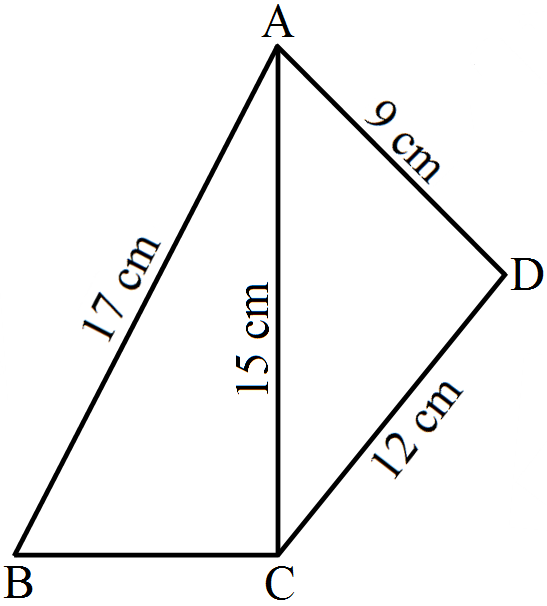
Find the perimeter and area of the quadrilateral ABCD in which AB = 17cm, AD = 9cm, CD = 12cm, $\angle\text{ACB} = 90^\circ$ and AC = 15cm.
Two concentric circles are of radii 5 cm and 3 cm. Find the length of the chord of the larger circle which touches the smaller circle.