Question
Prove the following Exercise:
$\int^{3}\limits_{1}\frac{\text{dx}}{\text{x}^{2}(\text{x}+1)}=\frac{2}{3}+\log\frac{2}{3}$

Answer

$\text{Let I}=\int^{3}\limits_{1}\frac{\text{dx}}{\text{x}^{2}(\text{x}+1)}$
Also, $\text{Let I}\int^{3}\limits_{1}\frac{1}{\text{x}^{2}(\text{x}+1)}=\frac{\text{A}}{\text{x}}+\frac{\text{B}}{\text{x}^{2}}+\frac{\text{C}}{\text{x}+1}$
$\Rightarrow1=\text{Ax(x}+1)+\text{B}\text{(x}+1)+\text{C}(\text{x}^{2})$
$\Rightarrow1=\text{Ax}^{2}+\text{Ax}+\text{Bx}+\text{B}+\text{Cx}^{2}$
Equating the Coefficient of $\text{x}^{2},\text{x}$ and constant term, we obtain 
$\text{A}+\text{C}=0$
$\text{A}+\text{B}=0$
$\text{B}=1$
On solving these equation, we obtain
$\text{A}=-1,\text{C}=1,\ \text{and B}=1$
$\therefore\frac{1}{\text{x}^{2}(\text{x}+1)}=-\frac{1}{\text{x}}+\frac{1}{\text{x}^{2}}+\frac{1}{(\text{x}+1)}$
$\Rightarrow\text{I}=\int^{3}\limits_{1}\left\{-\frac{1}{\text{x}}+\frac{1}{\text{x}^{2}}+\frac{1}{\text{(x}+1)}\right\}\text{dx}$
$=\bigg[-\log\text{x}-\frac{1}{\text{x}}+\log(\text{x}+1)\bigg]^{3}_{1}$
$=\bigg[-\log\bigg(\frac{\text{x}+1}{\text{x}}\bigg)-\frac{1}{\text{x}}\bigg]^{3}_{1}$
$=\log4-\log3-\log2+\frac{2}{3}$
$=-\log2-\log3+\frac{2}{3}$
$=\log\Big(\frac{2}{3}\Big)+\frac{2}{3}$
Hence, the given result is proved

Need a full question paper?

Generate a complete, print-ready paper with questions like this in minutes — across 16+ boards, with answer keys.
Start Generating Free

Similar questions

If $\text{x}-\text{e}^{\tan\text{x}}+\sqrt{\frac{\text{x}^2+1}{2}},$ find $\frac{\text{dy}}{\text{dx}}$
Evaluate the following integrals:
$\int\text{x}\cos^3\text{x}^2\sin\text{x}^2\text{ dx}$
Differential equation $\frac{\text{d}^2\text{y}}{\text{dx}^2}-\text{y}=0,\text{y}(0)=2,\text{y}'(0)=0$ Function $\text{y}=\text{e}^\text{x}+\text{e}^{-\text{x}}$
Evaluate the following definite integral as limit of sum:$\int_\limits{0}^{4}\text{(x}+\text{e}^{2\text{x}})\ \text{dx}$
Find the angle between the following pairs of lines:$\frac{\text{x}-1}{2}=\frac{\text{y}-2}{3}=\frac{\text{z}-3}{-3}$ and $\frac{\text{x}+3}{-1}=\frac{\text{y}-5}{8}=\frac{\text{z}-1}{4}$
If $\text{y}=500\text{e}^{7\text{x}}+600\text{e}^{-7\text{x}}$ prove that $\frac{\text{d}^2\text{y}}{\text{dx}^2}=49\text{y}.$
Test whether the following relations $R_{3 }$ are:
  1. Reflexive.
  2. Symmetric.
  3. Transitive.
$R_3$ on $R$ defined by $(\text{a, b})\in\text{R}_3\Leftrightarrow\ \text{a}^2-4\text{ab}+3\text{b}^2=0$
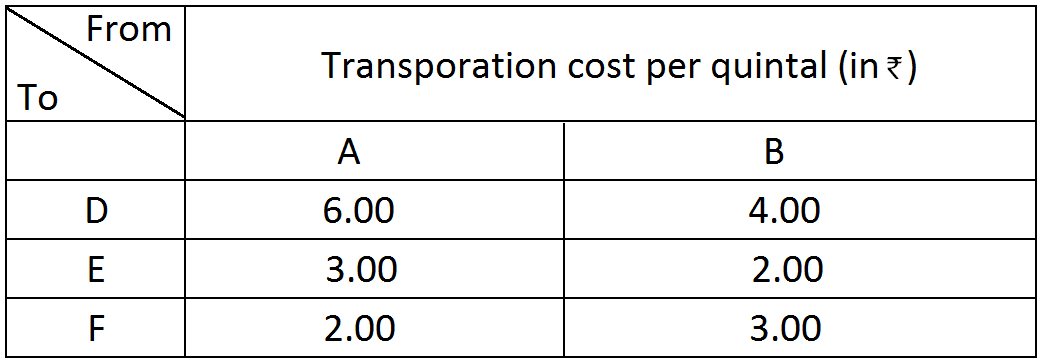
Tow godowns$, A$ and $B,$ have grain storage capacity of $100$ quintals and $50$ quintals respectively. They supply to $3$ ration shops, $D, E$ and $F,$ whose requirements are $60, 50$ and $40$ quintals respectively. The cost of transportation per quintal from the godowns to the shops are given in the following table:
How should the supplies be transported in order that the transportation cost is minimum? 
Find the angle between the lines whose direction cosines are given by the equations: $2l + 2m - n = 0, mn + ln + lm = 0$
Find the points of local maxima or local minima, if any, of the following functions, using the first derivatives test. Also, find the local maximum or local minimum values, as the case may be: 
$\text{f}(\text{x})=\sin2\text{x},0\leq\text{x}\leq\pi$