Question
Prove the following identities:
$\frac{\big(1+\tan^2\theta\big)\cot\theta}{\text{cosec}^2\theta}=\tan\theta$

Answer

$\text{L.H.S.}=\frac{\big(1+\tan^2\theta\big)\cot\theta}{\text{cosec}^2\theta}=\frac{\sec^2\theta\cot\theta}{\text{cosec}^2\theta}$
$=\frac{1}{\cos^2\theta}\times\frac{\cos\theta}{\sin\theta}\times\sin^2\theta=\frac{\sin\theta}{\cos\theta}$ $\Big[\because\big(1+\tan^2\theta\big)=\sec^2\theta\Big]$
$=\tan\theta$
$=\text{R.H.S.}$
Hence, LHS = RHS.

Need a full question paper?

Generate a complete, print-ready paper with questions like this in minutes — across 16+ boards, with answer keys.
Start Generating Free

Similar questions

Show that A (-4, -7),B (-1, 2), C (8, 5) and D (5, -4) are the vertices of a parallelogram.
In the following, determine whether the given values are solution of the given equation or not:
$\text{a}^2\text{x}^2-3\text{abx}+2\text{b}^2=0,$ $\text{x}=\frac{\text{a}}{\text{b}},\text{x}=\frac{\text{b}}{\text{a}}$
Find the value of $k$ for which the following equations have real and equal roots:
$x^2 - 2(k + 1)x + k^2 = 0$
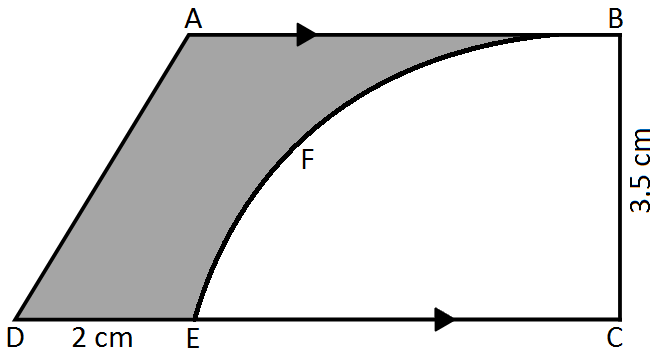
From a thin metallic piece, in the shape of a trapezium ABCD, in which $\text{AB} || \text{CD}$ and $\angle\text{BCD}=90^\circ,$ a quarter circle BEFC is removed (in the following figure). Given AB = BC = 3.5cm and DE = 2cm, calculate the area of the remaining piece of the metal sheet.
A farmer connects a pipe of internal diameter $25\ cm$ from a canal into a cylindrical tank in his field, which is $12m$ in diameter and $2.5m$ deep. If water flows through the pipe at the rate of $3.6$km/hr, then in how much time Will the tank be filled? Also, find the cost of water if the canal department charges at the rate of $₹ 0.07\ per\ m^3.$
If the radii of the conical frustum bucket are 14 cm and 7 cm. If its height is 30 cm, then find (i) Its total surface area (ii) capacity of the bucket.
The diameter and thickness of a hollow metals sphere are 12 cm and 0.01 m respectively. The density of the metal is 8.88 gm per cm3. Find the outer surface area and mass of the sphere.
The product of two consecutive positive integers is $306$. Find the integers.
Prove the following identities:
$\frac{\text{cosec }\theta+\cot\theta}{\text{cosec }\theta-\cot\theta}=(\text{cosec }\theta+\cot\theta)^2$
$=1+2\cot^2\theta+2\text{ cosec }\theta\cot\theta$
If Q(0, 1) is equidistant from P(5, -3) and R(x, 6), find the values of x. Also, find the distances QR and PR.