Question
Prove the following identities:
$\sec\theta(1-\sin\theta)(\sec\theta+\tan\theta)=0$

Answer

$\text{L.H.S.}=\sec\theta(1-\sin\theta)(\sec\theta+\tan\theta)$ $=\Big[\sec\theta-\frac{\sin\theta}{\cos\theta}\Big]\times\big(\sec\theta+\tan\theta\big)$ $=(\sec\theta-\tan\theta)(\sec\theta+\tan\theta)$ $=\big(\sec^2\theta-\tan^2\theta\big)=1$ $=\text{R.H.S.}$$\therefore\ \text{L.H.S.}=\text{R.H.S}$

Need a full question paper?

Generate a complete, print-ready paper with questions like this in minutes — across 16+ boards, with answer keys.

Start Generating Free

Similar questions

The weights of tea in 70 packets are shown in the following table:
Weight (in gram)
Number of packets
200-201
201-202
202-203
203-204
204-205
205-206
13
27
18
10
1
1
Find the mean weight of packets.
Two years ago, a man was five times as old as his son. Two years later, his age will be 8 more than three times the ago of the son. Find their present ages.
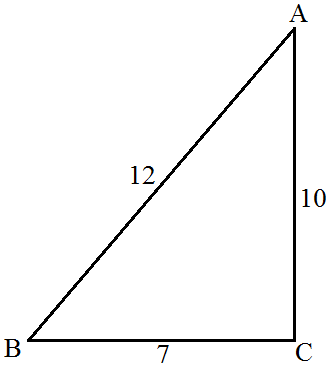
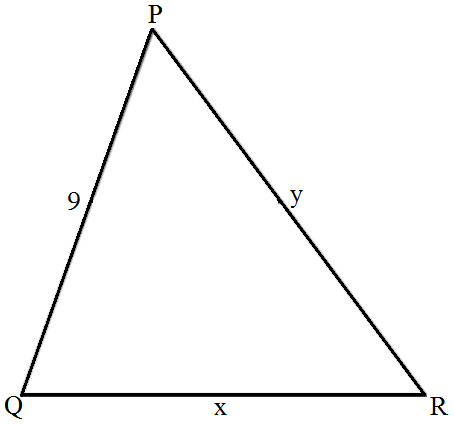
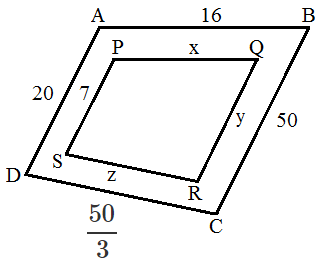
In the given figure, given that $\triangle\text{ABC}\sim\triangle\text{PQR}$ and quad ABCD ∼ quad PQRS. Determine the value of x, y, z in each case.
  1.  
  1.  
  1.  
If $x =-2$ is a root of the equation $3 x^2+7 x+p=0$, find the value of k so that the roots of the equation$x^2+k(4 x+k-1)+p=0$ are equal.
As observed from the top of a 75 m high lighthouse from the sea level, the angles of depression of two ships are $30^{\circ}$ and $45^{\circ}$ If one ship is exactly behind the other on the same side of the lighthouse, find the distance between the two ships (Use $\sqrt{3}=1.732)$
The following are the ages of 300 patients getting medical treatment in a hospital on a particular day:
Age (in years)
10-20
20-30
30-40
40-50
50-60
60-70
Number of patients
60
42
55
70
53
20
Form a 'less than type' cumulative frequency distribution.
A well of diameter 4 m is dug 14 m deep. The earth taken out is spread evenly all around the well to form a 40 cm high embankment. Find the width of the embankment.
Solve the following quadratic equation:
$\frac{\text{x}}{\text{x}+1}+\frac{\text{x}+1}{\text{x}}=2\frac{4}{15},$ $\text{x}\neq0,-1$
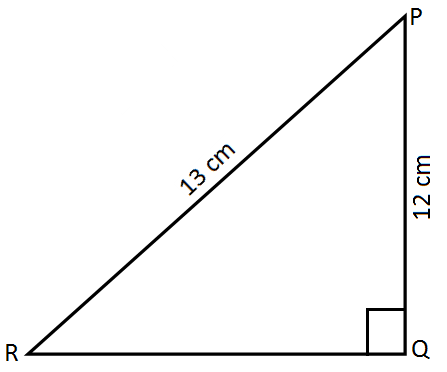
In the given figure, find tan P and cot R. Is tan P = cot R?
If the sum of the first $p$ terms of an A.P. is the same as the sum of its first q terms (where $p \neq q$ ), then show that the sum of first $(p+q)$ terms is zero