Question
Prove the following identity:
$
\frac{\sec A-1}{\sec A+1}=\frac{\sin ^2 A}{(1+\cos A)^2}
$

Answer

$
\begin{aligned}
& \text { LHS }=\frac{\sec A-1}{\sec A+1} \\
& =\frac{\frac{1}{\cos A}-1}{\frac{1}{\cos A}+1}=\frac{1-\cos A}{1+\cos A} \\
& =\frac{1-\cos A}{1+\cos A} \times \frac{1+\cos A}{1+\cos A} \\
& =\frac{1-\cos ^2 A}{(1+\cos A)^2} \\
& =\frac{\sin ^2 A}{(1+\cos A)^2} \quad\left(\because 1-\cos ^2 A=\sin ^2 A\right)
\end{aligned}
$

Need a full question paper?

Generate a complete, print-ready paper with questions like this in minutes — across 16+ boards, with answer keys.
Start Generating Free

Similar questions

The sides of a right-angled triangle are $(x – 1)\ cm, 3x\ cm$ and $(3x + 1)\ cm.$ Find:(1) the value of $x,$
(2) the lengths of its sides,
(3) its area.
Eight metallic spheres; each of radius $2 mm,$ are melted and cast into a single sphere. Calculatethe radius of the new sphere.
A school collected Rs 2100 for charity. It was decided to divide the money between an orphanage and a blind school in the ratio of 3 : 4. How much money did each receive?
Calculate the co-ordinates of the point P which divides the line segment joining: A $(1, 3)$ and B $(5, 9)$ in the ratio $1 : 2$
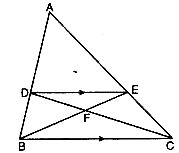
In the given figure, ABC is a triangle. DE is parallel to BC and $\frac{ AD }{ DB }=\frac{3}{2}$.
(i) Determine the ratios $\frac{ AD }{ AB }, \frac{ DE }{ BC }$.
(ii) Prove that ΔDEF is similar to ΔCBF.
Hence, find $\frac{ EF }{ FB }$
(iii) What is the ratio of the areas of ΔDEF and ΔBFC?

The value of a machine depreciates by $10\%, 12\%$ and $15\%$ in the first $3$ years. Express the total depreciation of the machine as a single per cent during the three years.
If the product of two positive consecutive even integers is $288$, find the integers.
There are two cones. The curved surface area of one is twice that of the other. The slant heightof the latter is twice that of the former find the ratio of their radii.
Show that the points $A(1, 3), B(2, 6), C(5, 7)$ and $D(4, 4)$ are the vertices of a rhombus.
$=a\left(\frac{1}{t^2}+1\right)=\frac{a\left(t^2+1\right)}{t^2}$
$\text { Now } \frac{1}{ SP }+\frac{1}{ SQ }=\frac{1}{a\left(t^2+1\right)}+\frac{1 \times t^2}{a\left(t^2+1\right)}$
$=\frac{\left(1+t^2\right)}{a\left(t^2+1\right)}$
$\frac{1}{ SP }+\frac{1}{ SQ }=\frac{1}{a} .$
Find the volume of a cone whose slant height is $17\ cm$ and radius of base is $8\ cm.$