Question
Prove the following trigonometric identities.
$\frac{1+\cos\text{A}}{\sin^2\text{A}}=\frac{1}{1-\cos\theta}$

Answer

We know that $\sin^2\text{A}+\cos^2\text{A}=1$
$\sin^2\text{A}=1-\cos^2\text{A}$
$\Rightarrow\ \sin^2\text{A}=(1-\cos\text{A})(1+\cos\text{A})$
$\Rightarrow\ \text{L.H.S}=\frac{(1+\cos\text{A})}{(1-\cos\text{A})(1+\cos\text{A})}=\frac{1}{1-\cos\text{A}}$
$\therefore\ \text{L.H.S}=\text{R.H.S}$
Hence proved.

Need a full question paper?

Generate a complete, print-ready paper with questions like this in minutes — across 16+ boards, with answer keys.
Start Generating Free

Similar questions

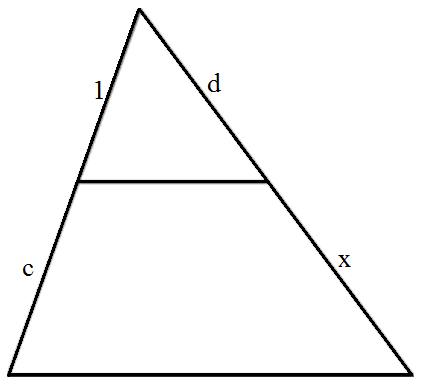
In the figure given below, a line segment is drawn parallel to one side of the triangle and the lengths of certain line-segment are marked. Find the value of x in the following:
A game consists of tossing a one-rupee coin 3 times and noting its outcome each time. Hanif wins if all the tosses give the same result i.e., three heads or three tails and loses otherwise. Calculate the probability that Hanif will lose the game.
If $3 \tan \theta=4$, evaluate $\frac{3 \sin \theta+2 \cos \theta}{3 \sin \theta-2 \cos \theta}$.
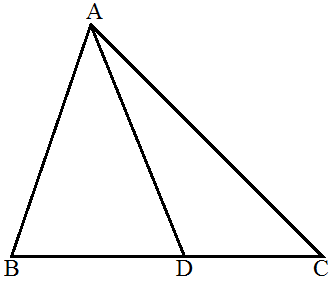
In FIg. check whether AD is the bisector of $\angle\text{A}$ of $\triangle\text{ABC}$ in the following.

AB = 5cm, AC = 12cm, BD = 2.5cm and BC = 9cm.
A copper wire when bent in the form of a square encloses an area of $484cm^2$​​​​​​​ The same wire is now bent in the form of d circle. find the area enclosed by the circle. $\Big[\text{Use }\pi=\frac{22}{7}\Big]$
If (1, 2), (4, y), (x, 6) and (3, 5) are the vertices of a parallelogram taken in order, find x and y.
Very-short and Short-Answer Questions.
Write the value of $\sec^2\theta(1+\sin\theta)(1-\sin\theta).$
The shape of the cross section of a canal is a trapezium. If the canal is $10\ m$ wide at the top, 6m wide at the bottom and the area of its cross section is $640m^2$​​​​​​​, find the depth of the canal.
On comparing the ratios $\frac { a _ { 1 } } { a _ { 2 } } , \frac { b _ { 1 } } { b _ { 2 } }$ and $\frac {c_1}{c_2}$, find out whether the lines representing the pair of linear equations intersect at a point, are parallel or coincident: 5x – 4y – 8 = 0; 7x + 6y – 9 = 0.
Prove that $2+3 \sqrt{3}$ is an irrational number. It is given that $\sqrt{3}$ is an irrational number.