Question
Prove the following trigonometric identities.
$\frac{1+\cos\theta-\sin^2\theta}{\sin\theta(1+\cos\theta)}=\cot\theta$

Answer

$\text{L.H.S}=\frac{(1+\cos\theta)-\sin^2\theta}{\sin\theta(1+\cos\theta)}$
$=\frac{(1+\cos\theta)-(1-\cos^2\theta)}{\sin\theta(1+\cos\theta)}$
$=\frac{(1+\cos\theta)-(1-\cos\theta)(1+\cos\theta)}{\sin(1+\cos\theta)}$
$=\frac{(1+\cos\theta)(1-1+\cos\theta)}{\sin\theta(1+\cos\theta)}$
$=\frac{\cos\theta}{\sin\theta}$
$=\cot\theta=\text{R.H.S}$
$\therefore\ \text{L.H.S}=\text{R.H.S}$

Need a full question paper?

Generate a complete, print-ready paper with questions like this in minutes — across 16+ boards, with answer keys.
Start Generating Free

Similar questions

Find the sum:
$3 + 11 + 19 + ..... + 803.$
Prove that $\frac{(1+\sin\theta)}{(1-\sin\theta)}=(\sec\theta+\tan\theta)^2.$
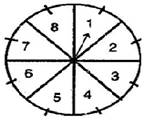
A game of chance consists of spinning an arrow which comes to rest pointing at one of the numbers 1, 2, 3, 4, 5, 6, 7, 8 (see figure) and these are equally likely outcomes. What is the probability that it will point at:

  1. 8?
  2. an odd number?
  3. a number greater than 2?
  4. a number less than 9?
Find the discriminant of the following equation:
$\text{2x}^2-5\sqrt{2\text{x}}+4=0$
On comparing the ratios $ \frac { a _ { 1 } } { a _ { 2 } } , \frac { b _ { 1 } } { b _ { 2 } } $ and $\frac { c _ { 1 } } { c _ { 2 } }$, find out whether the pair of linear equations are consistent, or inconsistent: 2x − 3y = 8, 4x − 6y = 9.
What is the nature of root of the quadratic equation $4x^2 - 12x - 9 = 0.$
The wheel of a motor cycle is of radius $35\ cm$. How many revolutions per minute must the wheel make so as to keep a speed of 66km/hr?
An arc subtends an angle of 90° at the centre of the circle of the radius 14cm. Write the area of minor sector thus formed in terms of $\pi.$
A cottage industry produces a certain number of toys in a day. The cost of production of each toy (in rupees) was found to be $55$ minus the number of toys produced in a day. On a particular day, the total cost of production was ₹ $750$. We would like to find out the number of toys produced on that day. Represent the situations mathematically (quadratic equation).
Find:
$18^{th}$ term of the A.P. $\sqrt{2},3\sqrt{2},5\sqrt{2},\ .....$