Question
Prove the following trigonometric identities.
$\frac{1}{\sec\text{A}-1}+\frac{1}{\sec\text{A}+1}=2\text{cosec A}\cot\text{A}$

Answer

We need to prove $\frac{1}{\sec\text{A}-1}+\frac{1}{\sec\text{A}+1}=2\text{cosec A}\cot\text{A}$
Solving the L.H.S, we get
$\text{L.H.S}=\frac{1}{\sec\text{A}-1}+\frac{1}{\sec\text{A}+1}=\frac{\sec\text{A}+1+\sec \text{A}-1}{(\sec\text{A}-1)(\sec\text{A}+1)}$
$=\frac{2\sec\text{A}}{\sec^2\text{A}-1}$
Further using the property $1+\tan^2\theta=\sec^2\theta,$ we get
So,
$\frac{2\sec\text{A}}{\sec^2\text{A}-1}=\frac{2\sec\text{A}}{\tan^2\text{A}}$
$=\frac{2\Big(\frac{1}{\cos\text{A}}\Big)}{\frac{\sin^2\text{A}}{\cos^2\text{A}}}$
$=2\frac{1}{\cos\text{A}}\times\frac{\cos^2\text{A}}{\sin^2\text{A}}$
$=2\Big(\frac{\cos\text{A}}{\sin\text{A}}\Big)\times\frac{1}{\sin\text{A}}$
$=2\text{cosec A}\cot\text{A}=\text{R.H.S}$
$\therefore\ \text{L.H.S}=\text{R.H.S}$

Need a full question paper?

Generate a complete, print-ready paper with questions like this in minutes — across 16+ boards, with answer keys.

Start Generating Free

Similar questions

Find an AP whose $4^{\text {th }}$ term is 9 and the sum of its $6^{\text {th }}$ and $13^{\text {th }}$ terms is 40 .
Points A(-1, y) and B(5, 7) lie on a circle with centre O(2, -3y). Find the values of y.
Find the median from the following data:
Class
1-5
6-10
11-15
16-20
21-25
26-30
31-35
35-40
41-45
Frequency
7
10
16
32
24
16
11
5
2
If $S_n$​​​​​​​ denotes the sum of first n terms of an A.P., prove that $S_{12} = 3(S_8 - S_4).$
If the point P(x, y) is equidistant from the points A(5, 1) and B(-1, 5), prove that 3x = 2y.
Find the zeros of the following quadratic polynomial and verify the relationship between the zeros and their coefficients:
$\text{f}(v)=v^2+4\sqrt{3}v-15$
Two taps running together can fill a tank in $3 \frac{1}{13}$ hours. If one tap takes 3 hours more than the other to fill the tank, then how much time will each tap take to fill the tank?
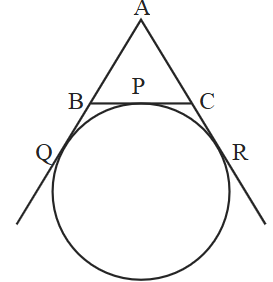
A circle touches the side $B C$ of a $\triangle A B C$ at a point $P$ and touches $A B$ and $A C$ when produced at $Q$ and $R$ respectively. Show that $AQ =\frac{1}{2} ($Perimeter of $\triangle A B C ).$
Image
Prove the following trigonometric identities.
If $\text{x}=\text{a}\sec\theta\cos\phi,\text{y}=\text{b}\sec\theta\sin\phi\text{ and z}=\text{c}\tan\theta,$ show that $\frac{\text{x}^2}{\text{a}^2}+\frac{\text{y}^2}{\text{b}^2}-\frac{\text{z}^2}{\text{c}^2}=1.$
Find the number of metallic circular discs with 1.5cm base diameter and of height 0.2cm to be melted to form a right circular cylinder of height 10cm and diameter
4.5cm.