Question
Prove the following trigonometric identities.
$(1+\tan^2\text{A})+\Big(1+\frac{1}{\tan^2\text{A}}\Big)=\frac{1}{\sin^2\text{A}-\sin^4\text{A}}$
Answer

We need to prove $(1+\tan^2\text{A})+\Big(1+\frac{1}{\tan^2\text{A}}\Big)=\frac{1}{\sin^2\text{A}-\sin^4\text{A}}$
Using the property $1+\tan^2\theta=\sec^2\theta,$ we get
$\text{L.H.S}=(1+\tan^2\text{A})+\Big(1+\frac{1}{\tan^2\text{A}}\Big)=\sec^2\text{A}+\Big(\frac{\tan^2\text{A}+1}{\tan^2\text{A}}\Big)$
$=\sec^2\text{A}+\Big(\frac{\sec^2\text{A}}{\tan^2\text{A}}\Big)$
Now, using $\sec\theta=\frac{1}{\cos\theta}\text{ and }\tan\theta=\frac{\sin\theta}{\cos\theta},$ we get
$\sec^2\text{A}+\Big(\frac{\sec^2\text{A}}{\tan^2\text{A}}\Big)=\frac{1}{\cos^2\text{A}}+\Bigg(\frac{\frac{1}{\cos^2\text{A}}}{\frac{\sin^2\text{A}}{\cos^2\text{A}}}\Bigg)$
$=\frac{1}{\cos^2\text{A}}+\Big(\frac{1}{\cos^2\text{A}}\times\frac{\cos^2\text{A}}{\sin^2\text{A}}\Big)$
$=\frac{1}{\cos^2\text{A}}+\frac{1}{\sin^2\text{A}}$
$=\frac{\sin^2\text{A}+\cos^2\text{A}}{\cos^2\text{A}(\sin^2\text{A})}$
Further, using the peroperty, $\sin^2\theta+\cos^2\theta=1,$ we get
$\frac{\sin^2\text{A}+\cos^2\text{A}}{\cos^2\text{A}(\sin^2\text{A})}=\frac{1}{\cos^2\text{A}(\sin^2\text{A})}$
$=\frac{1}{(1-\sin^2\text{A})(\sin^2\text{A})}\ (\text{using}\cos^2\theta=1-\sin^2\theta)$
$=\frac{1}{\sin^2\text{A}-\sin^4\text{A}}=\text{R.H.S}$
$\therefore\ \text{L.H.S}=\text{R.H.S}$

Need a full question paper?

Generate a complete, print-ready paper with questions like this in minutes — across 16+ boards, with answer keys.

Start Generating Free

Similar questions

Solve the following quadratic equation:$12abx^2 - (9a^2 - 8b^2)x - 6ab = 0$
A student was asked to make a model shaped like a cylinder with two cones attached to its ends by using a thin aluminium sheet. The diameter of the model is 3 cm and its total length is 12 cm . If each cone has a height of 2 cm , find the volume of air contained in the model.
An iron pillar has some part in the form of a right circular cylinder and remaining in the form of a right circular cone.The radius of the base of each of cone and cylinder is $8 \ cm.$ The cylindrical part is $240 \ cm$ high and the conical part is $36 \ cm$ high. Find the weight of the pillar if one cubic $\ cm$ of iron weighs $7.8$ grams.
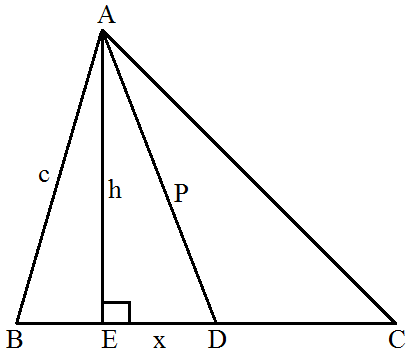
In the given figure, D is the mid-point of side BC and $\text{AE}\perp\text{BC}.$ If BC = a, AC = b, AB = c, ED = x, AD = p and AE = h, prove that:
  1. $\text{b}^2=\text{p}^2+\text{ax}+\frac{\text{a}^2}{4}$
  2. $\text{c}^2=\text{p}^2-\text{ax}+\frac{\text{a}^2}{4}$
  3. $\text{b}^2+\text{c}^2=2\text{p}^2+\frac{\text{a}^2}{4}$
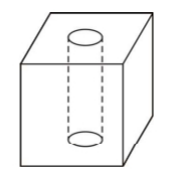
In Figure, from a solid cube of side 7 cm , a cylinder of radius 2.1 cm and height 7 cm is scooped out. Find the total surface area of the remaining solid.
Image
A solid rectangular block of dimensions 4.4m, 2.6m and 1m is cast into a hollow cylindrical pipe of internal radius 30cm and thickness ​5cm. Find the length of the pipe.
In an AP, the first term is -4, the last term is 29 and the sum of all its terms is 150. Find the common difference.
Find two natural numbers, the sum of whose squares is 25 times their sum and also equal to 50 times their difference.
A quadrilateral is drawn to circumscribe a circle. Prove that the sume of opposite sides are equal.
Find the area and perimeter of an isosceles right-angled triangle, each of whose equal sides measures 10cm. $\big[\text{Given}:\sqrt{2}=1.41\big]$