Question
Prove the following trigonometric identities.
$\Big(\frac{1}{\sec^2\theta-\cos^2\theta}+\frac{1}{\text{cosec}^2\theta-\sin^2\theta}\Big)\sin^2\theta\cos^2\theta=\frac{1-\sin^2\theta\cos^2\theta}{2+\sin^2\theta\cos^2\theta}$
Answer

$\text{L.H.S}=\Big(\frac{1}{\sec^2\theta-\cos^2\theta}+\frac{1}{\text{cosec}^2\theta-\sin^2\theta}\Big)\sin^2\theta\cos^2\theta$
$\Rightarrow \bigg[\frac{1}{\frac{1}{\cos^2\theta}-\cos^2\theta}+\frac{1}{\text{cosec}^2\theta-\sin^2\theta}\bigg]\sin^2\theta\cos^2\theta$
$=\Bigg[\frac{1}{\frac{1-\cos^4\theta}{\cos^2\theta}}+\frac{1}{\frac{1-\sin^4\theta}{\sin^2\theta}}\Bigg]\sin^2\theta\cos^2\theta$
$=\Big[\frac{\cos^2\theta}{1-\cos^4\theta}+\frac{\sin^2\theta}{1-\sin^4\theta}\Big]\sin^2\theta\cos^2\theta$
$=\Big[\frac{\cos^2\theta}{\cos^2\theta+\sin^2\theta-\cos^4\theta}+\frac{\sin^2}{\cos^2\theta+\sin^2\theta-\sin^4\theta}\Big]\sin^2\theta\cos^2\theta$
$=\Big[\frac{\cos^2\theta}{\cos^2\theta(1-\cos^2\theta)+\sin^2\theta}+\frac{\sin^2}{\sin^2\theta(1-\sin^2\theta)+\cos^2\theta}\Big]\sin^2\theta\cos^2\theta$
$=\Big[\frac{\cos^2\theta}{\cos^2\theta\sin^2\theta+\sin^2\theta}+\frac{\sin^2\theta}{\sin^2\theta\cos^2\theta+\cos^2\theta}\Big]\sin^2\theta\cos^2\theta$
$=\bigg[\frac{\cos^2\theta}{\sin^2\theta(\cos^2\theta+1)}+\frac{\sin^2\theta}{\cos^2\theta(\sin^2\theta+1)}\bigg]\sin^2\theta\cos^2\theta$
$=\bigg[\frac{\cos^4\theta(1+\sin^2\theta)+\sin^4\theta(1+\cos^2\theta)}{\sin^2\theta\cos^2\theta(1+\cos^2\theta)(1+\sin^2\theta)}\bigg]\sin^2\theta\cos^2\theta$
$=\frac{\cos^4\theta(1+\sin^2\theta)+\sin^4\theta(1+\cos^2\theta)}{(1+\cos^2\theta)(1+\sin^2\theta)}$
$=\frac{\cos^4\theta+\cos^4\theta\sin^2\theta+\sin^4\theta+\sin^4\theta\cos^2\theta}{1+\sin^2\theta+\cos^2\theta+\cos^2\theta\sin^2\theta}$
$=\frac{1-2\sin^2\theta\cos^2\theta+\sin^2\theta\cos^2\theta(\cos^2\theta+\sin^2\theta)}{1+1+\cos^2\theta\sin^2\theta}$
$(\because\ \cos^2\theta+\sin^2\theta=1)$
$=\frac{1-\sin^2\theta\cos^2\theta}{2+\sin^2\theta\cos^2\theta}=\text{R.H.S}$
$\therefore\ \text{L.H.S}=\text{R.H.S}$

Need a full question paper?

Generate a complete, print-ready paper with questions like this in minutes — across 16+ boards, with answer keys.

Start Generating Free

Similar questions

The $17^{\text {th }}$ term of an A.P. is 5 more than twice its $8^{\text {th }}$ term. If the $11^{\text {th }}$ term of the A.P. is 43 . find the $n^{\text {th }}$ term.
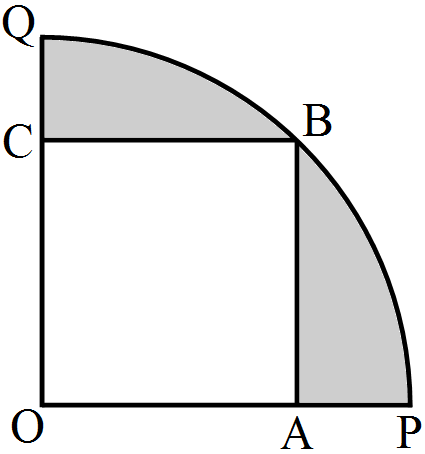
In the given figure, a square OABC is inscribed in a quadrant OPBQ of a circle. if OA = 20cm, find the area of the shaded region. $\big[\text{Use }\pi=3.14\big]$
Show that the points (-4, -1), (-2, -4) (4, 0) and (2, 3) are the vertices points of a rectangle.
A rocket is in the form of a circular cylinder closed at the lower end and a cone of the same radius is attached to the top. The radius fo the cylinder is 2.5m, its height is 21m and the slant height of the cone is 8m. Calculate the total surface area of rocket.
A die is rolled twice. Find the probability that:5 will come up exactly one time.
A man busy a number of pens for Rs. 180. If he had bought 3 more pens for the same amount, each pen would have cost him Rs. 3 less. How many pens did he buy?
Find the zeroes of the following polynomials by factorisation method and verify the relations between the zeroes and the coefficients of the polynomials:
$4\text{x}^2+5\sqrt{2\text{x}}-3$.
Using graphical method, solve the following system of equations :
$
3 x+y+4=0 \text { and } 3 x-y+2=0
$
Which term of the A.P. 3, 10, 17, ... will be 84 more than its $13^{th}$​​​​​​​ term?
A rocket is in the form of a circular cylinder closed at the lower end with a cone of the same radius attached to the top. The cylinder is of radius 2.5m and height 21m and the cone has the slant height 8m. Calculate the total surface area and the volume of the rocket.