Question
Prove the following trigonometric identities.
$\frac{\cos\text{A}}{1-\tan\text{A}}+\frac{\sin\text{A}}{1-\cot\text{A}}=\sin\text{A}+\cos\text{A}$
Answer

$\text{L.H.S}=\frac{\cos\text{A}}{1-\tan\text{A}}+\frac{\sin\text{A}}{\Big(1-\frac{1}{\tan\text{A}}\Big)}$
$=\frac{\cos\text{A}}{1-\tan\text{A}}-\frac{\sin\text{A}.\tan\text{A}}{1-\tan\text{A}}$
$\Rightarrow\ \frac{\cos\text{A}-\sin\text{A}\tan\text{A}}{(1-\tan\text{A})}$
$\Rightarrow\ \frac{\cos\text{A}-\sin\text{A}\times\frac{\sin\text{A}}{\cos\text{A}}}{1-\frac{\sin\text{A}}{\cos\text{A}}}$
$\Rightarrow\ \frac{\cos^2\text{A}-\sin^2\text{A}\cos\text{A}}{(\cos\text{A}-\sin\text{A})\cos\text{A}}$
$=\frac{(\cos\text{A}-\sin\text{A})(\cos\text{A}+\sin\text{A})}{\cos\text{A}-\sin\text{A}}$
$\Rightarrow\ \cos\text{A}+\sin\text{A}=\text{R.H.S}$
$\therefore \text{L.H.S}=\text{R.H.S}$

Need a full question paper?

Generate a complete, print-ready paper with questions like this in minutes — across 16+ boards, with answer keys.

Start Generating Free

Similar questions

The annual profits earned by 30 shops of a shopping complex in a locality give rise to the following distribution:
Profit (in lakhs in ₹)
No. of shops (frequency)
More than or equal to 5
30
More than or equal to 10
28
More than or equal to 15
16
More than or equal to 20
14
More than or equal to 25
10
More than or equal to 30
7
More than or equal to 35
3
Draw both ogives for the above data and hence obtain the median.
Evaluate the following:
If A = 30°, verify that:
$\sin2\text{A}=\frac{2\tan\text{A}}{1+\tan^2\text{A}}$
Determine the $AP$ whose 3rd term is $5$ and the $7th$ term is $9$.
Find the cubic polynomial with the sum, sum of the product of its zeros taken two at a time, and product of its zeros as 3, -1 and -3 respectively.
Write the sum of real roots of the equation $x^2 + |x| - 6 = 0$
From the top of a $7 \ m$ high building, the angle of elevation of the top of a cable tower is $60^o$ and the angle of depression of its foot is $45^o​​​​​​​$​​​​​​​. Determine the height of the tower.
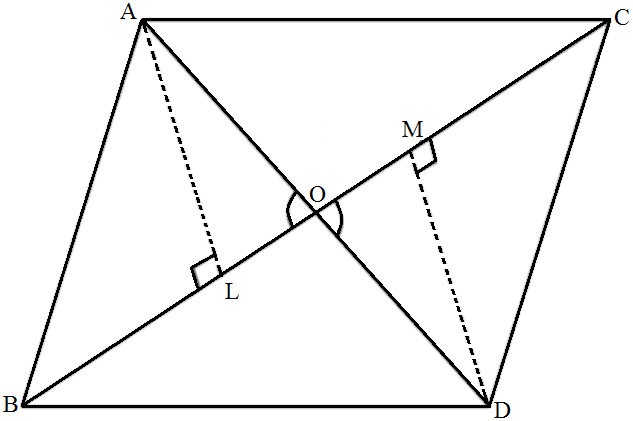
In the given figure, $\triangle\text{ABC}$ and $\triangle\text{DBC}$ are on the same base BC. If AD and BC intersect at O, prove that $\therefore\frac{\text{Area}(\triangle\text{ABC)}}{\text{Area}(\triangle\text{DBC})}=\frac{\text{AO}}{\text{DO}}$
In the following, determine whether the given values are solution of the given equation or not:
$x^2 + x + 1 = 0, x = 0, x = 1$
Find the area of the triangle $\text{ABC}$ with $(1,-4)$ and mid $-$ points of sides through $A$ being $(2,-1)$ and. $(0,-1)$
The sum of $5^{\text {th }}$ and $9^{\text {th }}$ terms of an $A.P.$ is $72$ and the sum of $7^{th}$ and $12^{th}$ terms is $97$ .Find the $A.P.$