Question
Prove the following trigonometric identities.
$\frac{\cos\theta-\sin\theta+1}{\cos\theta+\sin\theta-1}=\text{cosec}\theta+\cot\theta$

Answer

$\text{L.H.S}=\frac{\cos\theta-\sin\theta+1}{\cos\theta+\sin\theta-1}$
$=\frac{\frac{\cos\theta}{\sin\theta}-\frac{\sin\theta}{\sin\theta}+\frac{1}{\sin\theta}}{\frac{\cos\theta}{\sin\theta}+\frac{\sin\theta}{\sin\theta}-\frac{1}{\sin\theta}}$
$=\frac{\cot\theta-1+\text{cosec}\theta}{\cot\theta+1-\text{cosec}\theta}$
$=\frac{\cot\theta+\text{cosec}\theta-(\text{cosec}^2\theta-\cot^2\theta)}{(\cot\theta-\text{cosec}\theta+1)}$
$=\frac{\cot\theta+\text{cosec}\theta(1-\text{cosec}\theta+\cot\theta)}{(1-\text{cosec}\theta+\cot\theta)}$
$=\cot\theta+\text{cosec }\theta$
$=\text{R.H.S}$
$\therefore \text{L.H.S}=\text{R.H.S}$

Need a full question paper?

Generate a complete, print-ready paper with questions like this in minutes — across 16+ boards, with answer keys.
Start Generating Free

Similar questions

Prove the following trigonometric identities.
$\frac{\cos\text{A cosec A}-\sin\text{A}\sec\text{A}}{\cos\text{A}+\sin\text{A}}=\text{cosec A}-\sec\text{A}$
A bucket is in the form of a frustum of a cone and holds $28.490$ litres of water. The radii of the top and bottom are $28\ cm$ and $21\ cm$ respectively. Find the height of the bucket.
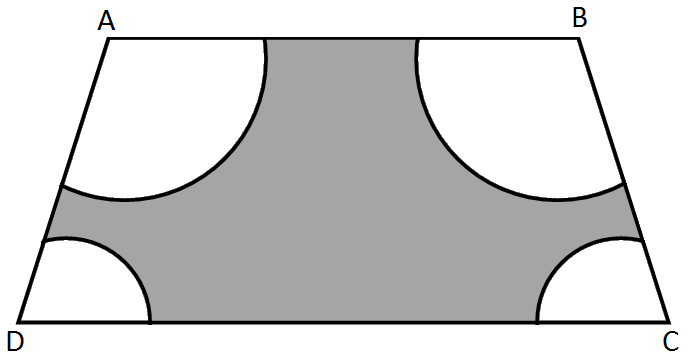
In the given figure, ABCD is a trapezium with $\text{AB}||\text{DC},\text{AB}=18\text{cm}$ DC = 32cm and the distance between AB and DC is 14cm. Circles of equal radii 7cm with centres A, B, C and D have been drawn. Then find the area of the shaded region.$\Big(\text{Use }\pi=\frac{22}{7}\Big)$
Prove that: $\frac{\cos ^3 \theta+\sin ^3 \theta}{\cos \theta+\sin \theta}+\frac{\cos ^3 \theta-\sin ^3 \theta}{\cos \theta-\sin \theta}=2$.
Find the zeros of the following quadratic polynomial and verify the relationship between the zeros and the coefficients:
$x^2 + 3x - 10$
Prove that: $\frac{1}{\operatorname{cosec} A-\cot A}-\frac{1}{\sin A}=\frac{1}{\sin A}-\frac{1}{\operatorname{cosec} A+\cot A}$.
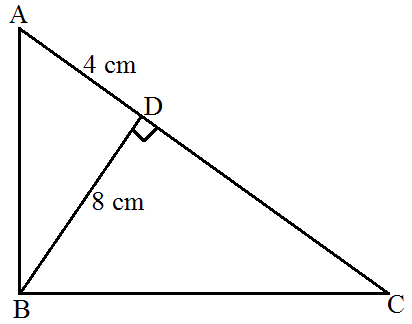
In the given figure, $\angle\text{ABC}=90^\circ$ and $\text{BD}\perp\text{AC}.$ If BD = 8cm and AD = 4cm, find CD.
Show that the system of equations:
$\text{6x}+\text{5y}=11,\ \text{9x}+\frac{15}{2}\text{y}=21$
has no solutions.
Find the value of k for which the following system of equations has no solution:
$2x - ky + 3 = 0$
$3x + 2y - 1 = 0$
A box contains 90 discs which are numbered 1 to 90 . If one disc is drawn at random from the box, find the probability that it bears a :
(i) 2-digit number less than 40 .
(ii) number divisible by 5 and greater than 50 .
(iii) a perfect square number.