Question
Prove the following trigonometric identities.
$\frac{\cot^2\text{A}(\sec\text{A}-1)}{1+\sin\text{A}}=\sec^2\text{A}\Big(\frac{1-\sin\text{A}}{1+\sin\text{A}}\Big)$
Answer

We have to prove $\frac{\cot^2\text{A}(\sec\text{A}-1)}{1+\sin\text{A}}=\sec^2\text{A}\Big(\frac{1-\sin\text{A}}{1+\sin\text{A}}\Big)$
We know that, $\sin^2\text{A}+\cos^2\text{A}=1$
So,
$\text{L.H.S}=\frac{\cot^2\text{A}(\sec\text{A}-1)}{1+\sin\text{A}}=\sec^2\text{A}\Big(\frac{1-\sin\text{A}}{1+\sin\text{A}}\Big)$
$=\frac{\frac{\cos^2\text{A}}{\sin^\text{2}\text{A}}\big(\frac{1}{\cos\text{A}}-1\Big)}{1+\sin\text{A}}$
$=\frac{\frac{\cos^2\text{A}}{\sin^2\text{A}}\frac{1-\cos\text{A}}{\cos\text{A}}}{1+\sin\text{A}}$
$=\frac{\cos\text{A}(1-\cos\text{A})}{\sin^2\text{A}(1+\sin\text{A})}$
$=\frac{\cos\text{A}(1-\cos\text{A})}{(1-\cos^2\text{A})(1+\sin\text{A})}$
$=\frac{\cos\text{A}(1-\cos\text{A})}{(1-\cos\text{A})(1+\cos\text{A})(1+\sin\text{A})}$
$=\frac{\cos\text{A}}{(1+\cos\text{A})(1+\sin\text{A})}$
$=\frac{\frac{1}{\sec\text{A}}}{\Big(1+\frac{1}{\sec\text{A}}\Big)(1+\sin\text{A})}$
$=\frac{\frac{1}{\sec\text{A}}}{\Big(\frac{\sec\text{A}+1}{\sec\text{A}}\Big)(1+\sin\text{A})}$
$=\frac{1}{(\sec\text{A}+1)(1+\sin\text{A})}$
Multiplying both the numerator ans denominator by $(1-\sin\text{A})$ we have
$=\frac{(1-\sin\text{A})}{(\sec\text{A}+1)(1+\sin\text{A})(1-\sin\text{A})}$
$=\frac{1-\sin\text{A}}{(\sec\text{A}+1)\cos^2\text{A}}$
$=\frac{(1-\sin\text{A})}{(\sec\text{A}+1)\cos^2\text{A}}$
$=\sec^2\text{A}\frac{(1-\sin\text{A})}{(\sec\text{A}+1)}$
$=\sec^2\text{A}\Big(\frac{1-\sin\text{A}}{1+\sec\text{A}}\Big)=\text{R.H.S}$
$\therefore\ \text{L.H.S}=\text{R.H.S}$

Need a full question paper?

Generate a complete, print-ready paper with questions like this in minutes — across 16+ boards, with answer keys.

Start Generating Free

Similar questions

Solve the following quadratic equation:
$4^{(x+1)} + 4^{(1-x)} = 10$
A drinking glass is in the shape of the frustum of a cone of height 14 cm. The diameters of its two circular ends are 4 cm and 2 cm. Find the capacity of the glass. [Use $\pi=\frac{22}{7}$ ]
$A$ and $B$ jointly finish a piece of work in $15$ days. When they work separately, A takes $16$ days less than the number of days taken by $B$ to finish the same piece of work. Find the number of days taken by $B$ to finish the work.
Draw a circle with the help of a bangle. Take any point P outside the circle. Construct the pair of tangents from the point P to the circle.
For each of the following, find a quadratic polynomial whose sum and product respectively of the zeroes are as given. Also find the zeroes of these polynomials by factorisation.
$\frac{-3}{2\sqrt{5}}$, $-\frac{1}{2}$
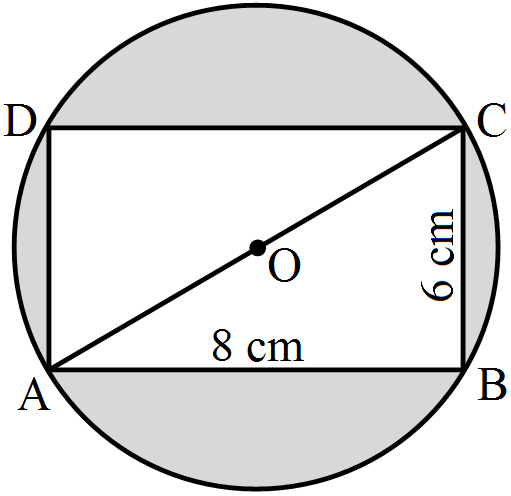
Find the area of the shaded region in the given figure, if ABCD is a rectangle with sides 8cm and 6cm and O is the centre of the circle.
Find the roots of the quadratic equations by using the quadratic formula in each of the following:
$\frac{1}{2}\text{x}^2-\sqrt{11}\text{x}+1=0.$
If 10 times the $10^{\text {th }}$ term of an AP is equal to 15 times the $15^{\text {th }}$ term, show that its $25^{\text {th }}$ term is zero.
A tent of height 77dm is in the form of a right circular cylinder of diameter 36m and height 44dm surmounted by a right circular cone. Find the cost of the canvas at Rs. 3.50 per m$^2$ $\Big(\text{use}\ \pi=\frac{22}{7}\Big)$
If $\sin (\text{A} − \text{B}) = \sin \text{A} \cos \text{B} − \cos \text{A} \sin \text{B}$ and $\cos (\text{A − B}) = \cos\text{A} \cos\text{B} + \sin \text{A} \sin \text{B},$ find the values of sin 15° and cos 15°.