Question
Prove the following trigonometric identities.
$\frac{1-\sin\theta}{1+\sin\theta}=(\sec\theta-\tan\theta)^2$

Answer

$\text{L.H.S}=\frac{(1-\sin\theta)}{(1+\sin\theta)}$
$=\frac{1-\sin\theta}{1+\sin\theta}\times\frac{(1-\sin\theta)}{(1-\sin\theta)}$
$=\frac{(1-\sin\theta)^2}{(1-\sin^2\theta)}$
$=\frac{(1-\sin\theta)^2}{\cos^2\theta}$
$=\frac{1-2\sin\theta+\sin^2\theta}{\cos^2\theta}$
$=\frac{1}{\cos^2\theta}-2\frac{\sin\theta}{\cos^2\theta}+\frac{\sin^2\theta}{\cos^2\theta}$
$=\sec^2\theta-2\sec\theta\tan\theta+\tan^2\theta$
$=(\sec\theta-\tan\theta)^2=\text{R.H.S}$
$\therefore\ \text{L.H.S}=\text{R.H.S}$

Need a full question paper?

Generate a complete, print-ready paper with questions like this in minutes — across 16+ boards, with answer keys.
Start Generating Free

Similar questions

A(4, 2), B(6, 5) and C(1, 4) are the vertices of ΔABC.
What do you observe?
Solve the following quadratic equation by completing square method:
$4 p^2+7=12 p$
$\triangle\text{ABD}$ is a right triangle right-angled at A and $\text{AC}\perp\text{BD}.$ Show that
$AD^2 = BD \times CD$
Show that the roots of the equation $x^2 + px - q^2 = 0$ are real for all real value of p and q.
Without actually performing the long division, state whether state whether the following rational numbers will have a terminating decimal expansion or a non terminating repeating decimal expansion.
$\frac{35}{50}$
Write sample space ‘S’ and number of sample point n(S) for each of the following experiments. Also write events A, B, C in the set form and write n(A), n(B), n(C).
From three men and two women, environment committee of two persons is to be formed.
Condition for event A : There must be at least one woman member.
Condition for event B : One man, one woman committee to be formed
Condition for event C : There should not be a woman member.

Which of the following sequences are A.P. ? If they are A.P. find the common difference.
$2, \frac{5}{2}, 3, \frac{7}{3}, \ldots \ldots$
Solve the following quadratic equation by factorization method:
$m^2-7=0$
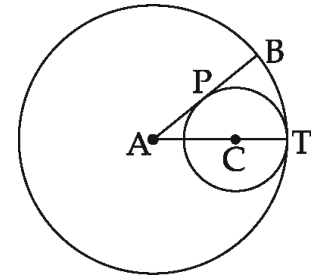
In the adjoining figure circles with centres A and C touch internally at point T. Line AB is tangent to the smaller circle at point P. Point B lies on the bigger circle. Radii are 16 cm and 6 cm. Find AP.
Image
Find the distance between the points:
$A(1, -3)$ and $B(4, -6)$