Question
Prove the following trigonometric identities.
$\frac{\sin\text{A}}{\sec\text{A}+\tan\text{A}-1}+\frac{\cos\text{A}}{\text{cosec A}+\cot\text{A}-1}=1$
Answer

$\text{L.H.S}=\frac{\sin\text{A}}{\frac{1}{\cos\text{A}}+\frac{\sin\text{A}}{\cos\text{A}}-1}+\frac{\cos\text{A}}{\frac{1}{\sin\text{A}}+\frac{\cos\text{A}}{\sin\text{A}}-1}$
$=\frac{\sin\text{A}}{\frac{1+\sin\text{A}-\cos\text{A}}{\cos\text{A}}}+\frac{\cos\text{A}}{\frac{1+\cos\text{A}-\sin\text{A}}{\sin\text{A}}}$
$=\frac{\sin\text{A}\cos\text{A}}{1+\sin\text{A}-\cos\text{A}}+\frac{\sin\text{A}\cos\text{A}}{1+\cos\text{A}-\sin\text{A}}$
$=\sin\text{A}\cos\text{A}\Big[\frac{1}{1+\sin\text{A}-\cos\text{A}}+\frac{1}{1+\cos\text{A}-\sin\text{A}}\Big]$
$=\sin\text{A}\cos\text{A}\Big[\frac{1+\cos\text{A}-\sin\text{A}+1+\sin\text{A}-\cos\text{A}}{(1+\sin\text{A}-\cos\text{A})(1+\cos\text{A}-\sin\text{A})}\Big]$
$=\sin\text{A}\cos\text{A}\Big[\frac{2}{1+\cos\text{A}-\sin\text{A}+\sin\text{A}+\sin\text{A}\cos\text{A}-\sin^2\text{A}-\cos\text{A}-\cos^2\text{A}+\cos\text{A}\sin\text{A}}\Big]$
$=\sin\text{A}\cos\text{A}\Big[\frac{2}{1-\sin^2\text{A}-\cos^2\text{A}+2\sin\text{A}\cos\text{A}}\Big]$
$=\sin\text{A}\cos\text{A}\Big[\frac{2}{1-(\sin^2\text{A}+\cos^2\text{A})+2\sin\text{A}\cos\text{A}}\Big]$
$=\sin\text{A}\cos\text{A}\Big[\frac{2}{1-1+2\sin\text{A}\cos\text{A}}\Big](\because \sin^2\text{A}+\cos^2\text{A}=1)$
$=\sin\text{A}\times\cos\text{A}\times\frac{2}{2\sin\text{A}\cos\text{A}}$
$=1=\text{R.H.S}$
$\text{L.H.S}=\text{R.H.S}$

Need a full question paper?

Generate a complete, print-ready paper with questions like this in minutes — across 16+ boards, with answer keys.

Start Generating Free

Similar questions

A sanitation committee of 2 members is to be formed from 3 boys and
2 girls. Write sample space ‘S’ and number of sample points n(S). Also write
the following events in set form and number of sample points in the event.
(i) Condition for event A : at least one girl must be a member of the committee.
(ii) Condition for event B : Committee must be of one boy and one girl.
(iii) Condition for event C : Committee must be of boys only.
(iv) Condition for event D : At the most one girl should be a member of the committee.
Which term of the AP $21, 18, 15, ....$ is zero?
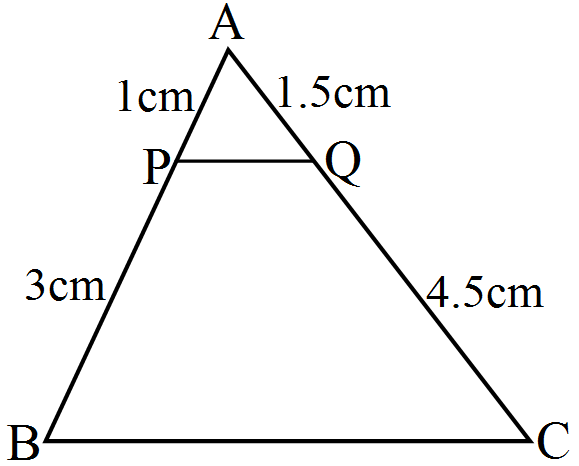
In the given figure, ABC is a triangle and PQ is a straight line meeting AB in P and AC in Q. If AP = 1cm. PB = 3cm, AQ = 1.5cm, QC = 4.5cm, Prove that area of $\triangle\text{APQ}$ is $\frac{1}{16}$ of the area of $\triangle\text{ABC}.$
$AD$ is an altitude of an equilateral triangle $ABC.$ On $AD$ as base, another equilateral triangle $ADE$ is constructed.
Prove that Area $(\triangle\text{ADE)}$ : Area $(\triangle\text{ABC)} = 3 : 4.$
The time required for students to do a science experiment and the number of students is shown in the following grouped frequency distribution table. Show the information by a histogram and also by a frequency polygon.
Time required for
Experiment (minutes)
20-2222-2424-2626-2828-3030-32
No. of students81622181412
The $24^{\text {th }}$ term of an A.P. is twice its $10^{\text {th }}$ term. Show that its $72^{\text {nd }}$ term is $4$ times its $15^{\text {th }}$ term.
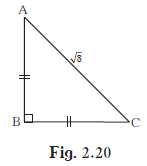
For finding AB and BC with the help of information given in figure 2.20, complete following activity.

$AB = BC \ldots \ldots \ldots \ldots$
$\therefore \quad \angle BAC =\square$
$\therefore AB = BC =\square \times AC$
$=\square \times \sqrt{8}$
$=\square \times 2 \sqrt{2}$
$=\square \times$
Prove that:$\frac23\text{cosec}^258^\circ-\frac23\cot58^\circ\tan32^\circ\\-\frac52\tan13^\circ\tan37^\circ\tan45^\circ\tan53^\circ\tan77^\circ=-1.$
Find the ratio in which the point $\text{P}\Big(\frac{3}{4},\frac{5}{12}\Big)$ divides the line segment joining the points $\text{A}\Big(\frac{1}{2},\frac{3}{2}\Big)$ and B(2, -5).
Prove that the points $(4, 5) (7, 6), (6, 3), (3, 2)$ are the vertices of a parallelogram. Is it a rectangle.