Question
Prove the following trigonometric identities.
If $\text{a }\cos^3\theta+3\text{a}\cos\theta\sin^2\theta=\text{m, a }\sin^3\theta+3\text{a}\cos^2\theta\sin\theta=\text{n},$ prove that $(\text{m}+\text{n})^\frac{2}{3}+(\text{m}-\text{n})^\frac{2}{3}=2\text{a}^\frac{2}{3}.$
Answer

Given that,
$\text{a}\cos^3\theta+3\text{a}\cos\theta\sin^2\theta=\text{m},$
$\text{a}\sin^3\theta+3\text{a}\cos^2\theta\sin\theta=\text{n}$
We have to prove $(\text{m}+\text{n})^\frac{2}{3}+(\text{m}-\text{n})^\frac{2}{3}=2\text{a}^\frac{2}{3}$
Adding both the equations, we get
$\text{m}+\text{n}=\text{a}\cos^3\theta+3\text{a}\cos\theta\sin^2\theta+\text{a}\sin^3\theta+3\text{a}\cos^2\theta\sin\theta$
$=\text{a}(\cos^3\theta+3\cos^2\theta\sin\theta+3\cos\theta\sin^2+\sin^3\theta)$
$=\text{a}(\cos\theta+\sin\theta)^3$
Also.
$\text{m}-\text{n}=\text{a}\cos^3\theta+3\text{a}\cos\theta\sin^2\theta-(\text{a}\sin^3\theta+3\text{a}\cos^2\theta\sin\theta)$
$=\text{a}(\cos^3\theta-3\cos^2\theta\sin\theta+3\cos\theta\sin^2-\sin^3\theta)$
$=\text{a}(\cos\theta-\sin\theta)^3$
Therefore, we have
$\text{L.H.S}=(\text{m}+\text{n})^\frac{2}{3}+(\text{m}-\text{n})^\frac{2}{3}$
$=\text{a}^\frac{2}{3}(\cos\theta+\sin\theta)^2+\text{a}^\frac{2}{3}(\cos\theta-\sin\theta)^2$
$=\text{a}^\frac{2}{3}\{(\cos\theta+\sin\theta)^2+(\cos\theta-\sin\theta)^2\}$
$=\text{a}^\frac{2}{3}\{(\cos^2\theta+2\cos\theta\sin\theta+\sin^2\theta)+(\cos^2\theta-2\cos\theta\sin\theta+\sin^2\theta)\}$
$=\text{a}^\frac{2}{3}\{(\cos^2\theta+\sin^2\theta+2\cos\theta\sin\theta)+(\cos^2\theta+\sin^2\theta-2\cos\theta\sin\theta)\}$
$=\text{a}^\frac{2}{3}\{(1+2\cos\theta\sin\theta)+(1-2\cos\theta\sin\theta)\}$
$=\text{a}^\frac{2}{3}(1+2\cos\theta\sin\theta+1-2\cos\theta\sin\theta)$
$=2\text{a}^\frac{2}{3}=\text{R.H.S}$
$\therefore\ \text{L.H.S}=\text{R.H.S}$

Need a full question paper?

Generate a complete, print-ready paper with questions like this in minutes — across 16+ boards, with answer keys.

Start Generating Free

Similar questions

Solve the following quadratic equations by factorization:
$\sqrt{2}\text{x}^2-3\text{x}-2\sqrt{2}=0$
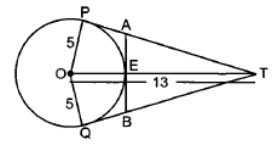
In figure, $O$ is the centre of a circle of radius $5 \ cm. T$ is a point such that $OT = 13 \ cm$ and $OT$ intersects circle at $E$. If $AB$ is a tangent to the circle at $E,$ find the length of $AB$. where $TP$ and $TQ$ are two tangents to the circle.
Image

Prove that the perpendicular at the point of contact to the tangent to a circle passes through the centre of the circle.

The angles of elevation of the top of a tower from two points at distances of 4m and 9m from the base of the tower and in the same straight line with it are complementary. Show that the height of the tower is 6 metres.
Solve the following systems of equations:
$\frac{\text{x}+\text{y}}{\text{xy}}=2,$
$\frac{\text{x}-\text{y}}{\text{xy}}=6.$
Find the common difference of the$ A.P$. and write the next two terms:
$119, 136, 153, 170, .....$
If a cone and a sphere have equal radii and equal volumes. What is the ratio of the diameter of the sphere to the height of the cone?
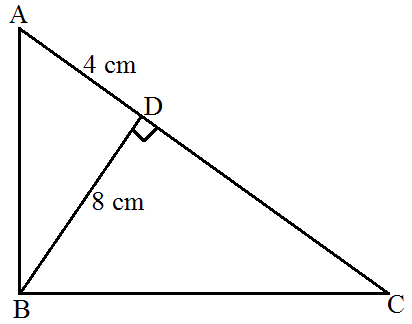
In the given figure, $\angle\text{ABC}=90^\circ$ and $\text{BD}\perp\text{AC}.$ If BD = 8cm and AD = 4cm, find CD.
Three unbiased coins are tossed simultaneously. Find the probability of getting :
(i) at least one head.
(ii) exactly one tail.
(iii) two heads and one tail.
From the top of a 50m high tower, the angles of depression of the top and bottom of a pole are observed to be 45° and 60° respectively. Find the height of the pole.