Question
Prove the following trigonometric identities.
If $\text{cosec }\theta-\sin\theta=\text{a}^3,\sec\theta-\cos\theta=\text{b}^3,$ prove that $a^2b^2 (a^2 + b^2) = 1$.
Answer

$\text{cosec }\theta-\sin\theta=\text{a}^3$
$\frac{1}{\sin\theta}-\sin\theta=\text{a}^3$
$\frac{1-\sin^2}{\sin\theta}=\text{a}^3$
$\frac{\cos^2\theta}{\sin\theta}=\text{a}^3$
$\text{a}=\frac{\cos^{\frac{2}{3}}\theta}{\sin^{\frac{1}{3}}\theta}$
$\Rightarrow\ \text{a}^2=\frac{\cos\frac{4}{3}\theta}{\sin\frac{2}{3}\theta}$
$\sec\theta-\cos\theta=\text{B}^3$
$\frac{1}{\cos\theta}-\cos\theta=\text{b}^3$
$\frac{1-\cos^2\theta}{\cos\theta}=\text{b}^3$
$\frac{\sin^2\theta}{\cos\theta}=\text{b}^3$
$\text{b}=\frac{\sin\frac{2}{3}\theta}{\cos\frac{1}{3}\theta}$
Now, $\text{L.H.S}=\text{a}^2\text{b}^2(\text{a}^2+\text{b}^2)$
$=\frac{\cos^{\frac{4}{3}}\theta}{\sin^{\frac{2}{3}}\theta}\times\frac{\sin^\frac{4}{3}\theta}{\cos^\frac{2}{3}\theta}\bigg(\frac{\cos^{\frac{4}{3}}\theta}{\sin^{\frac{2}{3}\theta}}+\frac{\sin^{\frac{4}{3}}\theta}{\cos^{\frac{2}{3}}\theta}\bigg)$
$=\cos^{\frac{4}{3}-\frac{2}{3}}\theta\sin^{\frac{4-2}{3}}\bigg(\frac{\cos^{\frac{4}{3}}\theta}{\sin^{\frac{2}{3}\theta}}+\frac{\sin^{\frac{4}{3}}\theta}{\cos^{\frac{2}{3}}\theta}\bigg)$
$=\cos^{\frac{2}{3}}\theta\sin^\frac{2}{3}\bigg(\frac{1}{\sin^{\frac{2}{3}}\theta\cos^{\frac{2}{3}}\theta}\bigg) \big(\because \cos^2\theta+\sin^2\theta=1\big)$
$=1=\text{R.H.S}$
$\therefore\ \text{L.H.S}=\text{R.H.S}$

Need a full question paper?

Generate a complete, print-ready paper with questions like this in minutes — across 16+ boards, with answer keys.

Start Generating Free

Similar questions

If first term of an A.P. is a, second term is b and last term is c, then show that sum of all terms is $\frac{(a+c)(b+c-2 a)}{2(b-a)}$.
Divide $57$ into two parts whose product is $680$.
Find the roots of the following quadratic equation (if they exist) by the method of completing the square.
$2\text{x}^2-7\text{x}+3=0$
In what ratio does the point C(4, 5) divide the join of A(2, 3) and B(7, 8)?
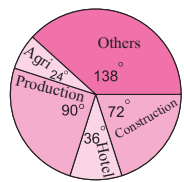
As deduced from a survey, the classification of skilled workers is shown in the pie diagram (fig 6.11). If the number of workers in the production sector is 4500, answer the following questions.(i) What is the total number of skilled workers in all fields?
(ii) What is the number of skilled workers in the field of constructions?
(iii) How many skilled workers are in agriculture?
(iv) Find the difference between the numbers of workers in the field of production and construction.
Image
Find the area of a triangle whose vertices are,
$(\text{at}_1^2, 2\text{at}_1), (\text{at}_2^2, 2\text{at}_2)$ and $(\text{at}_3^2, 2\text{at}_3).$
Evaluate the following:
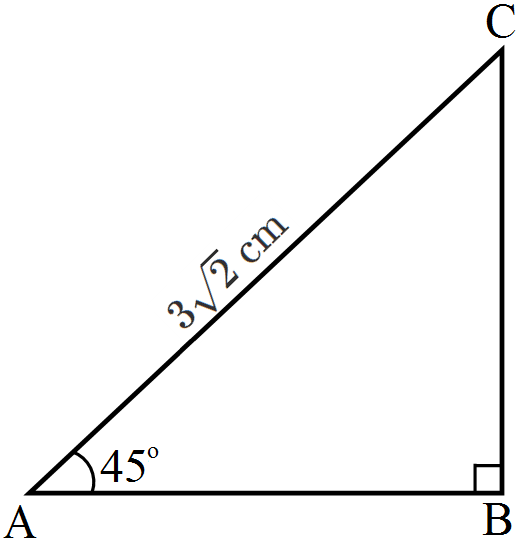
In the adjoining figure, $\triangle\text{ABC}$ is a right-angled at B and $\angle\text{A}=45^\circ,$ If $\text{AC}=3\sqrt{2}\text{cm},$
Find:
  1. BC.
  2. AB.
Draw a histogram for the following frequency distribution.
Use of electricity
(Unit)
50-7070-9090-110110-130130-150150-170
No. of families150400460540600350
Find the lengths of the medians of a triangle whose vertices are A(-1, 3), B(1, -1) and C(5, 1).
A takes 3 hours more than B to walk a distance of 30km. But, if A doubles his pace (speed) he is ahead of B by $1\frac{1}{2}$ hours. Find the speeds of A and B.