Question
Prove the following trigonometric identities.
If $\text{T}_\text{n}=\sin^\text{n}\theta+\cos^\text{n}\theta,$ porve that $\frac{\text{T}_3-\text{T}_5}{\text{T}_1}=\frac{\text{T}_5-\text{T}_7}{\text{T}_3}.$
Answer

In the given question, we are given $\text{T}_\text{n}=\sin^\text{n}\theta+\cos^\text{n}\theta$
We need to prove $\frac{\text{T}_3-\text{T}_5}{\text{T}_1}=\frac{\text{T}_5-\text{T}_7}{\text{T}_3}$
Here L.H.S is
$\text{L.H.S}=\frac{\text{T}_3-\text{T}_5}{\text{T}_1}=\frac{(\sin^3\theta+\cos^3\theta)-(\sin^5\theta+\cos^5\theta)}{(\sin\theta+\cos\theta)}$
Now, solving the L.H.S, we get
$\frac{(\sin^3\theta+\cos^3\theta)-(\sin^5\theta+\cos^5\theta)}{(\sin\theta+\cos\theta)}=\frac{\sin^3\theta-\sin^3\theta+\cos^3\theta-\cos^3\theta}{\sin\theta+\cos\theta}$
$=\frac{\sin^3\theta(1-\sin^2\theta)+\cos^3\theta(1-\cos^2\theta)}{\sin\theta+\cos\theta}$
Further using the property $\sin^2\theta+\cos^2\theta=1,$ we get
$\cos^2\theta=1-\sin^2\theta$
$\sin^2\theta=1-\cos^2\theta$
$=\frac{\sin^3\theta(1-\sin^2\theta)+\cos^3\theta(1-\cos^2\theta)}{\sin\theta+\cos\theta}=\frac{\sin^3\theta\cos^2\theta+\cos^3\theta\sin^2\theta}{\sin\theta+\cos\theta}$
$=\frac{\sin^2\theta\cos^2\theta(\sin\theta+\cos\theta)}{\sin\theta+\cos\theta}$
$=\sin^2\theta\cos^2\theta$
Now, solving the R.H.S, we get
$\text{R.H.S}=\frac{\text{T}_5-\text{T}_7}{\text{T}_3}=\frac{(\sin^5\theta+\cos^5\theta)-(\sin^7\theta+\cos^7\theta)}{(\sin^3\theta+\cos^3\theta)}$
So,
$\frac{(\sin^5\theta+\cos^5\theta)-(\sin^7\theta+\cos^7\theta)}{(\sin^3\theta+\cos^3\theta)}=\frac{\sin^5\theta-\sin^7\theta+\cos^5\theta-\cos^7\theta}{\sin^3\theta+\cos^3\theta}$
$=\frac{\sin^5\theta(1-\sin^2\theta)+\cos^5\theta(1-\cos^2\theta)}{\sin^3\theta+\cos^3\theta}$
Furhter using the property $\sin^2\theta+\cos^2\theta=1,$ we get,
$\text{cos}^2\theta=1-\sin^2\theta$
$\sin^2\theta=1-\cos^2\theta$
So,
$=\frac{\sin^5\theta(1-\sin^2\theta)+\cos^5\theta(1-\cos^2\theta)}{\sin^3\theta+\cos^3\theta}=\frac{\sin^5\theta\cos^2\theta+\cos^5\theta\sin^2\theta}{\sin^3\theta+\cos^3\theta}$
$=\frac{\sin^2\theta\cos^2\theta(\sin^3\theta+\cos^3\theta)}{\sin^3\theta+\cos^3\theta}$
$=\sin^2\theta\cos^2\theta$
$\therefore\ \text{L.H.S}=\text{R.H.S}$

Need a full question paper?

Generate a complete, print-ready paper with questions like this in minutes — across 16+ boards, with answer keys.

Start Generating Free

Similar questions

Solve the following quadratic equations by factorization:
$ax^2 + (4a^2 - 3b)x - 12ab = 0$
A boy standing at a distance of 48 meters from a building observes the top of the building and makes an angle of elevation of 30°. Find the height of the building.
Show that the □PQRS formed by P(2,1), Q(-1,3), R(-5,-3) and S(-2,-5) is a rectangle.
If $\text{x}=\frac{2}{3}$ and $x = -3$ are the roots of the quadratic equation $ax^2 + 7x + b = 0$ then find the values of $a$ and $b$.
Jamila spld a table and chair for ₹ 1050, there by making a profit of 10% on a table and 25% on the chair. If she had taken profit of 25% on the table and 10% on the chair she would have got ₹ 1065. Find the cost price of each.
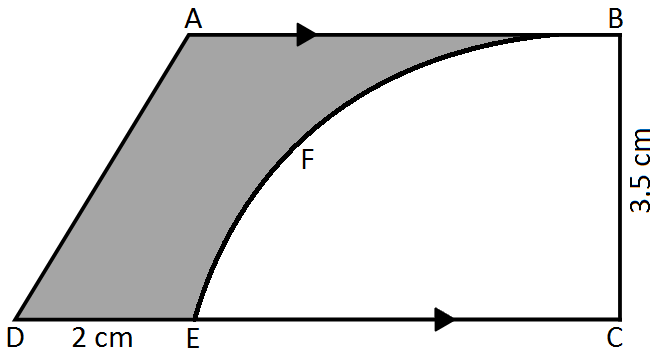
From a thin metallic piece, in the shape of a trapezium ABCD, in which $\text{AB} || \text{CD}$ and $\angle\text{BCD}=90^\circ,$ a quarter circle BEFC is removed (in the following figure). Given AB = BC = 3.5cm and DE = 2cm, calculate the area of the remaining piece of the metal sheet.
Find the area of a quadrant of a circle whose circumference is 88cm. $[\text{Take }\pi\ =3.14]$
The boat goes 30km upstream and 44km downstream in 10 hours. In 13 hours, it can go 40km upstream and 55km downstream. Determine the speed of stream and that of the boat in still water.
4 tables and 3 chairs, together, cost Rs. 2250 and 3 tables and 4 chairs cost Rs. 1950. Find the cost of 2 chairs and 1 table.
Find all possible values of $y$ for which the distance between the points $A(2,-3)$ and $B(10, y)$ is $10$ units.